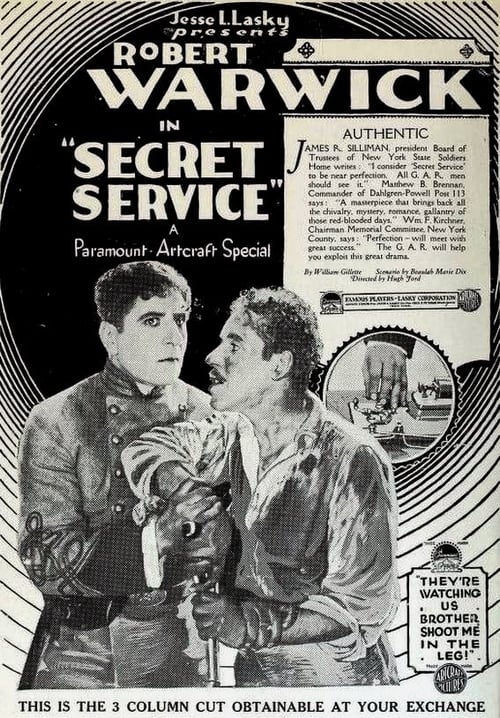
Secret Service
Plot
Lewis Dumont, a Northern officer in the American Civil War, works undercover behind Confederate lines in an attempt to lead Southern forces away from an area in which a Northern attack is planned. But Dumont falls in love with a Southern girl and when she proves useful to his plan, his conscience begins to tear at him.
Get the Weekly Woke Watchlist
New and trending movies scored for woke bias, preachy messaging, and forced political themes — before you waste your evening.
No spam. One useful email per week.
Overall Series Review
Categorical Breakdown
The plot centers on a Union officer's internal conflict regarding his mission and his love interest. Characters are judged entirely on their personal merit, loyalty, and honor, fitting the concept of Universal Meritocracy. The film is a 1919 production set during the Civil War, so there is no reliance on race, intersectional hierarchy, or the vilification of "whiteness" to drive the drama.
The film uses the American Civil War as a dramatic backdrop for a conflict of personal loyalty versus national duty. This involves a profound moral crisis for the protagonist, not a hostility toward Western civilization, one's home, or ancestors. The narrative respects the sacrifices of soldiers by framing the central conflict around honor and consequence.
The core dilemma rests with the male lead, Lewis Dumont, as he struggles with his duty and love for Edith Varney. The female character is the source of the man's moral conflict and his object of affection. There is no evidence of 'Mary Sue' or 'Girl Boss' tropes, emasculation of the male characters, or anti-natalist messaging. Gender roles follow a traditional, complementary structure.
The entire romantic plot is built upon a traditional male-female pairing, a heterosexual relationship between a spy and the sister of a Confederate officer. The film, a product of 1919, does not feature alternative sexualities, deconstruct the nuclear family, or engage in gender ideology lecturing. The structure is entirely normative.
The dramatic tension is explicitly rooted in the protagonist's "conscience" tearing at him, which invokes a sense of objective moral duty and higher moral law. The story prioritizes duty and moral consequence. No element of the plot or known themes suggests hostility toward religion or an embrace of moral relativism; the theme is built upon Transcendent Morality.
Get the Weekly Woke Watchlist
New and trending movies scored for woke bias, preachy messaging, and forced political themes — before you waste your evening.
No spam. One useful email per week.