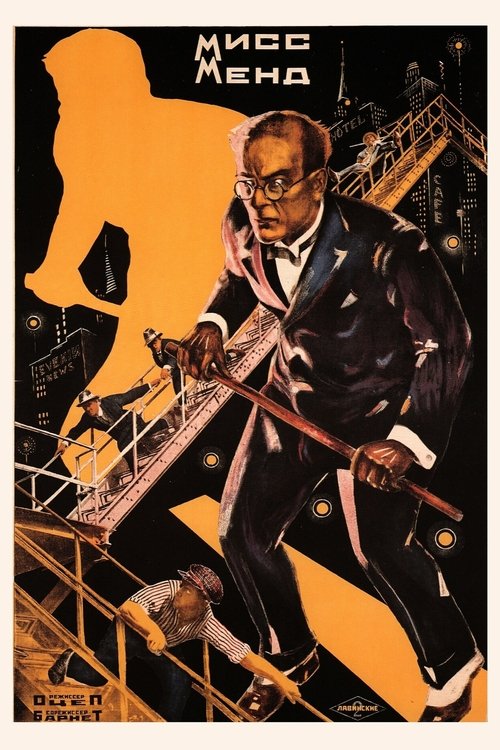
Miss Mend
Plot
Three reporters and an office girl are trying to stop a bacteriological strike by some powerful western business leaders against the USSR.
Get the Weekly Woke Watchlist
New and trending movies scored for woke bias, preachy messaging, and forced political themes — before you waste your evening.
No spam. One useful email per week.
Overall Series Review
Categorical Breakdown
The narrative’s entire conflict is a clear vilification of the Western capitalist elite (implicitly wealthy white men), who are depicted as a 'gigantic criminal conspiracy' capable of mass biological genocide for profit. The plot exists to critique an oppressive 'system' of capitalism. The film also includes pointed commentary on the treatment of minorities like blacks and Asians in early 20th century US society, aligning with a focus on systemic oppression based on immutable characteristics.
The film functions as Soviet propaganda, with a plot centered on 'Western business leaders' attempting to unleash plague-based biological weapons on the Soviet Union and framing the Bolsheviks. The Soviet police become the heroes who defeat the plot at the climax. This directly frames Western/American home culture (capitalism) as fundamentally corrupt and evil, and the rival external culture (the USSR) as morally superior, achieving a near-maximum score.
Vivian Mend is the titular heroine, an office typist who is politically 'radicalised' and takes decisive, physical action (like 'rugby tackling a police officer') to defend striking workers. She is the moral and political center of the group, and some male reporter characters are depicted as clueless or bumbling sidekicks. This is a strong 'Girl Boss' trope. The score is tempered by the fact that she is also devoted to caring for her young nephew.
The film contains no apparent references to alternative sexualities, gender ideology, or the deconstruction of the nuclear family. The main characters operate within a traditional male-female romantic sub-plot.
The conflict is purely ideological, revolving around the struggle between capitalism and communism (class warfare). There is no evidence of hostility toward religion, specifically Christianity, or discussion of spiritual themes; the moral framework is entirely political and secular.
Get the Weekly Woke Watchlist
New and trending movies scored for woke bias, preachy messaging, and forced political themes — before you waste your evening.
No spam. One useful email per week.