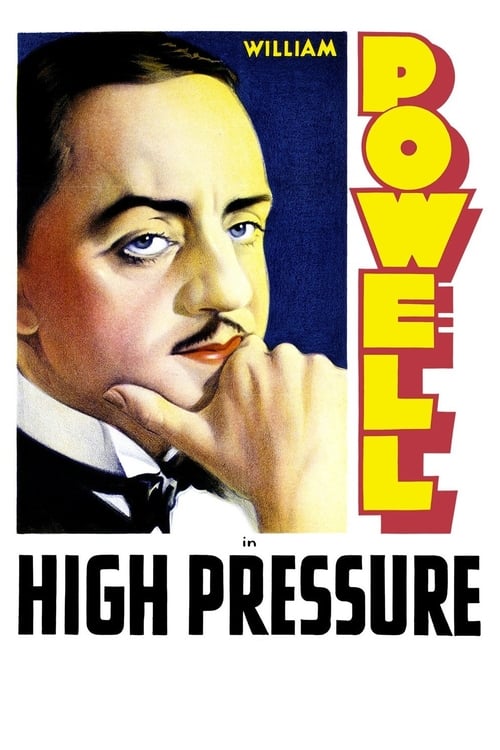
High Pressure
Plot
Gar Evans is a con artist, who pretends to be the owner of a "Golden Gate Artificial Rubber Company", and he is looking for investors. Finding them is relatively easy, but it becomes difficult when those want to see the inventor of the synthetic rubber...
Get the Weekly Woke Watchlist
New and trending movies scored for woke bias, preachy messaging, and forced political themes — before you waste your evening.
No spam. One useful email per week.
Overall Series Review
Categorical Breakdown
The film does not focus on intersectional hierarchy or vilification of whiteness. The protagonist, a white male, is an unscrupulous con artist, but this is a satire of financial hustling, not a lecture on systemic privilege. A character named Ginsburg, who introduces the scheme, is presented as a fairly stereotypical Jewish man, which reflects the period’s casual use of ethnic types, though he is not depicted as evil. Meritocracy is subverted by the protagonist's con artistry, which is the central conflict.
The narrative satirizes the greed and speculative excesses of the American business world and the 'get rich quick at any price' ethos during the Great Depression. This is an internal, self-critical critique of financial corruption, not a general hostility toward Western civilization, one’s home, or ancestors. The core institutions of law and order ultimately respond to the con, and the ending shows the main character reverting to his hucksterism, which is framed as an incorrigible personal flaw, not a reflection of a fundamentally corrupt society.
The female lead, Francine Dale, is a key figure who possesses high standards, moral clarity, and agency. She serves as the moral compass for the film and ultimately rejects the protagonist's chaotic, dishonest career path in favor of a stable life, even preparing to leave him for another man. She is not a 'Girl Boss' whose perfection is instantly established, and the male lead, while incompetent at honesty, is a charming, fast-talking rogue, not a bumbling idiot. The messaging celebrates a woman’s desire for marital stability over a chaotic, career-driven single life.
The film’s setting in 1932 and its genre as a fast-paced business comedy exclude any focus on alternative sexualities, gender ideology, or deconstruction of the nuclear family. All romantic subplots follow a traditional male-female pairing. Sexual identity is not a feature of the plot or character development. The structure is entirely normative.
The narrative is purely secular, revolving around financial fraud, stock promotion, and the business world. There is no presence of traditional religion, Christianity, or any hostility toward faith. The moral framework is one of secular honesty versus criminal con-artistry, not a debate on objective truth versus moral relativism. This theme is absent from the story.
Get the Weekly Woke Watchlist
New and trending movies scored for woke bias, preachy messaging, and forced political themes — before you waste your evening.
No spam. One useful email per week.