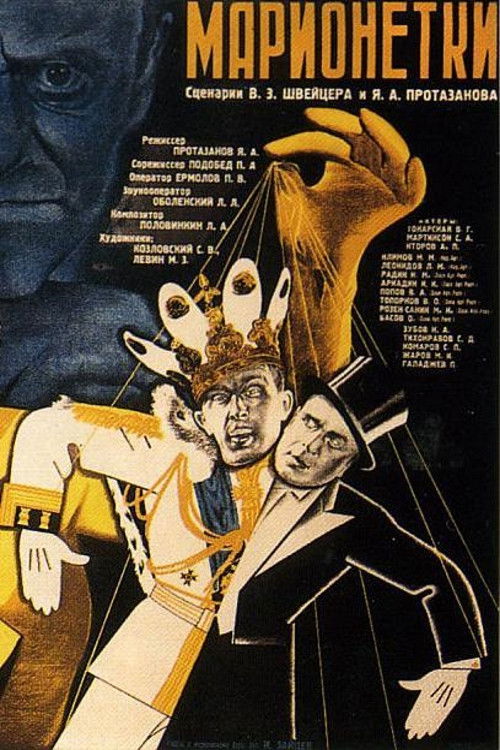
Marionettes
Plot
Fearing the Soviet Union, rich businessmen who want more influence in Europe decide to give the nation of Boufferia a new king, an easy to handle drunkard.
Get the Weekly Woke Watchlist
New and trending movies scored for woke bias, preachy messaging, and forced political themes — before you waste your evening.
No spam. One useful email per week.
Overall Series Review
Categorical Breakdown
The narrative operates entirely on a class-based group hierarchy, where the 'cabal of wealthy capitalists' and aristocrats are the villains, while the common people are an oppressed group 'radicalized by the example of the USSR.' This is a vilification of the Western-coded, traditional, wealthy male power structure, which is depicted as incompetent, corrupt, and conspiratorial.
The film is an explicit piece of Soviet antifascist and anti-capitalist propaganda that frames the political, financial, and religious institutions of a fictional European (Western-coded) monarchy as fundamentally corrupt, chaotic, and warmongering. The narrative suggests that all of these core institutions are fundamentally flawed, while the Soviet Union is presented as the inspiring, superior external model.
The main female character, Mi, is 'The Singing Star' and the 'Prince's Fiancée,' a glamorous figure who is an appendage of the dissolute and corrupt aristocracy. Her role is to be part of the elite being satirized, not a 'Girl Boss' or an independent, modern female protagonist. The focus of the satire is political and class-based, not gender-based.
The film’s focus is entirely on anti-capitalist and antifascist political satire. There is no evidence of themes related to alternative sexualities, gender ideology, or the deconstruction of the nuclear family.
The Archbishop (Re) is explicitly named as a member of the 'reactionary coalition' and a co-conspirator alongside the fascists and the cabal of wealthy capitalists who are attempting to start a war with the USSR. This portrays the leader of a traditional religious institution as a corrupt, anti-people, and integral part of the political evil being satirized.
Get the Weekly Woke Watchlist
New and trending movies scored for woke bias, preachy messaging, and forced political themes — before you waste your evening.
No spam. One useful email per week.