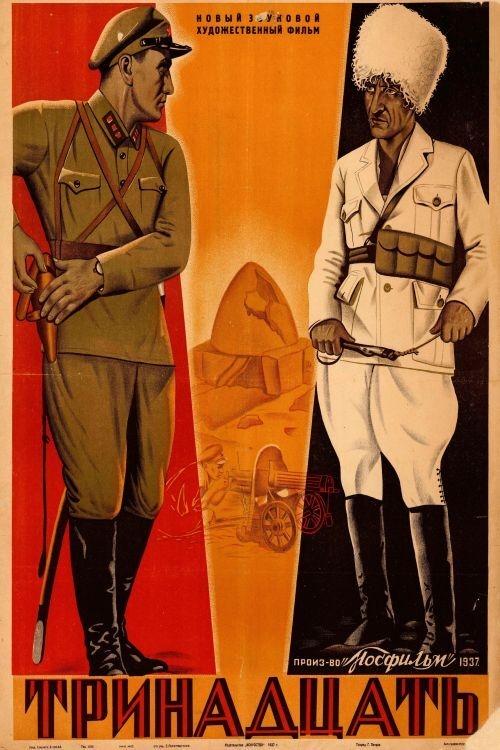
The Thirteen
Plot
The film tells about a band of demobilized Red Army men and two civilians who cross a Middle Asian desert. They are forced to do battle with superior forces of Basmachi rebels for the dry draw-well.
Get the Weekly Woke Watchlist
New and trending movies scored for woke bias, preachy messaging, and forced political themes — before you waste your evening.
No spam. One useful email per week.
Overall Series Review
Categorical Breakdown
The film’s central conflict is ideological (Soviet versus Basmachi/White Russian reactionaries), superseding any modern intersectional hierarchy. The heroes are a collection of Red Army soldiers, including a non-Slavic character, all judged by their collective heroism and merit in battle for the Soviet cause, which is a form of universal meritocracy within the Soviet framework.
The narrative is a strong celebration of the 'home culture' of the Soviet project and the Red Army, framing their sacrifices as necessary for the creation and protection of the new society. It views core Soviet institutions and the Red Army's ancestors as shields against feudal chaos and reactionary forces, directly opposing the definition of civilizational self-hatred.
The sole female character is the commander's wife, who is portrayed as a supportive and heroic partner. She takes up arms and sacrifices herself alongside the men. This role emphasizes shared sacrifice and complementary partnership in a time of crisis rather than showing men as incompetent or promoting anti-natalism and career-over-motherhood messaging.
The story is a focused military adventure with an emphasis on survival and duty. The only relationship presented is the traditional male-female pairing of the commander and his wife. The film contains no presence of alternative sexual ideology, queer theory, or deconstruction of the nuclear family structure.
As a film produced under the officially anti-theistic Soviet regime, the underlying ideology opposes traditional religion. However, the plot's conflict is purely secular: a fight for a well and survival. The narrative does not contain overt lectures or philosophical arguments framing religion (specifically Christianity) as the root of evil or promoting moral relativism, instead promoting a collective, objective Soviet moral code.
Get the Weekly Woke Watchlist
New and trending movies scored for woke bias, preachy messaging, and forced political themes — before you waste your evening.
No spam. One useful email per week.