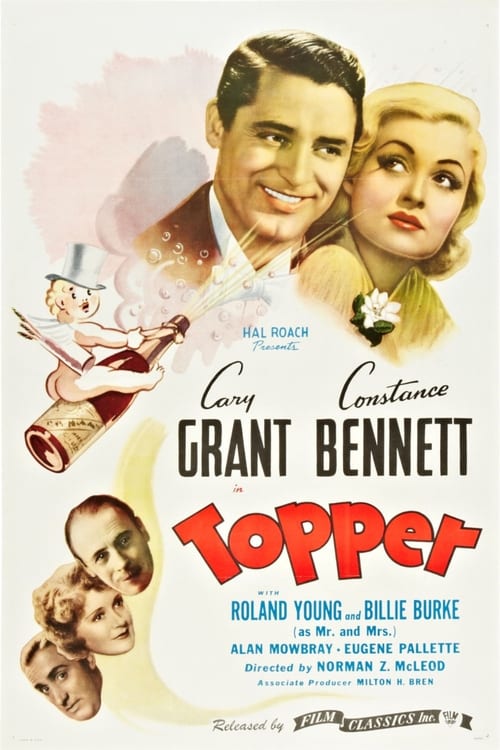
Topper
Plot
Madcap couple George and Marion Kerby are killed in an automobile accident. They return as ghosts to try and liven up the regimented lifestyle of their friend and bank president, Cosmo Topper. When Topper starts to live it up, it strains relations with his stuffy wife.
Get the Weekly Woke Watchlist
New and trending movies scored for woke bias, preachy messaging, and forced political themes — before you waste your evening.
No spam. One useful email per week.
Overall Series Review
Categorical Breakdown
Characters are judged by their personal character, specifically their temperament and lifestyle—carefree versus stuffy—rather than immutable characteristics. The film, typical of its era, features a historically authentic, nearly all-white cast, and the conflict centers entirely on class and personality dynamics. The narrative features no commentary on privilege, race-swapping, or vilification of 'whiteness.'
The film’s critique is aimed at the specific rigid, joyless personal life of the main character, Cosmo Topper, and his restrictive marriage. It does not frame Western civilization, its core institutions, or its ancestors as fundamentally corrupt or racist. The movie is a celebration of a glamorous, wealthy, and fun-loving high-society lifestyle.
The story sets up Cosmo Topper's conservative and restrictive wife, Clara, as the primary antagonist to fun and liberation. This demonizes the restrictive version of the traditional wife, pushing the score above a 1. The female ghost Marion, a sophisticated socialite, is one of the key instigators in leading a man to a more 'vital' life, but she is not a 'Girl Boss' focused on career, nor is she portrayed as instantly perfect, as she must perform a good deed to get to heaven.
The narrative's central dynamics involve a traditional heterosexual marriage and an extramarital-like, albeit ghostly, romantic entanglement. The focus remains on normative male-female pairing and a critique of a stuffy marriage, not the deconstruction of the nuclear family as an institution itself. There is no presence of sexual ideology or lecturing on alternative sexualities or gender theory.
The entire plot premise depends on the belief in an afterlife and an objective moral framework: the ghosts are stuck in limbo and must perform a 'good deed' to earn entry into heaven. The acknowledgement of a transcendent moral consequence serves as the catalyst for the comedy, affirming a form of higher moral law.
Get the Weekly Woke Watchlist
New and trending movies scored for woke bias, preachy messaging, and forced political themes — before you waste your evening.
No spam. One useful email per week.