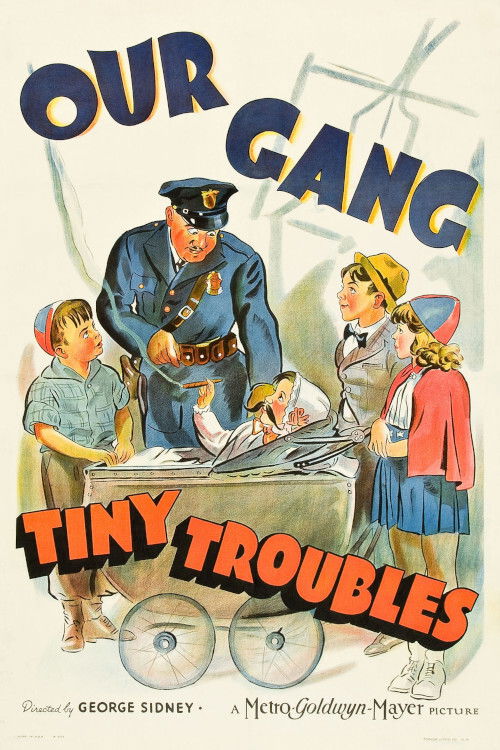
Tiny Troubles
Plot
Alfalfa "trades in" his whining baby brother for another baby--who turns out to be a midget criminal.
Get the Weekly Woke Watchlist
New and trending movies scored for woke bias, preachy messaging, and forced political themes — before you waste your evening.
No spam. One useful email per week.
Overall Series Review
Categorical Breakdown
The film’s central conflict is driven by Alfalfa's personal frustration, not by race or immutable characteristics. Characters are judged solely on their comedic behavior and actions, which leads to Alfalfa and the gang being chastised for their bad judgment. The cast is racially diverse without the narrative drawing political attention to it, aligning with a universal meritocracy of childhood play.
There is no hostility toward Western civilization, one's home, or ancestors. The action takes place in a stable, normal, working-class home, and the chaos is imported by the external criminal element. The film ends with a reaffirmation of the institutions of the nuclear family and the judicial system (the judge's moral lecture) as shields against chaos.
The main focus is on a male child's incompetence with childcare and his rejection of a baby brother. While the mother's role is relegated to a domestic figure who leaves the baby with Alfalfa, female characters like Darla have minimal dialogue. The core story does not feature a 'Girl Boss' or 'Mary Sue' trope, nor does it explicitly frame motherhood as a prison; it is simply the backdrop for Alfalfa's folly. The score is only slightly above the absolute minimum due to the traditional, non-celebrated domestic depiction of the mother.
The short film adheres entirely to a normative structure, featuring a traditional male-female pairing in the backdrop (Alfalfa’s parents) and centering on the standard nuclear family unit of siblings. There is no presence of sexual ideology, centering of alternative sexualities, or deconstruction of biological reality or the family structure.
The movie is secular in its immediate setting, but its morality is transcendent and objective. The plot resolves with the intervention of the police and a judge, who is depicted as a stern, fair figure delivering a clear moral law and consequence (probation) for the children’s actions. Faith is not discussed, but the authority of objective truth and moral law is fully acknowledged by the state institution.
Get the Weekly Woke Watchlist
New and trending movies scored for woke bias, preachy messaging, and forced political themes — before you waste your evening.
No spam. One useful email per week.