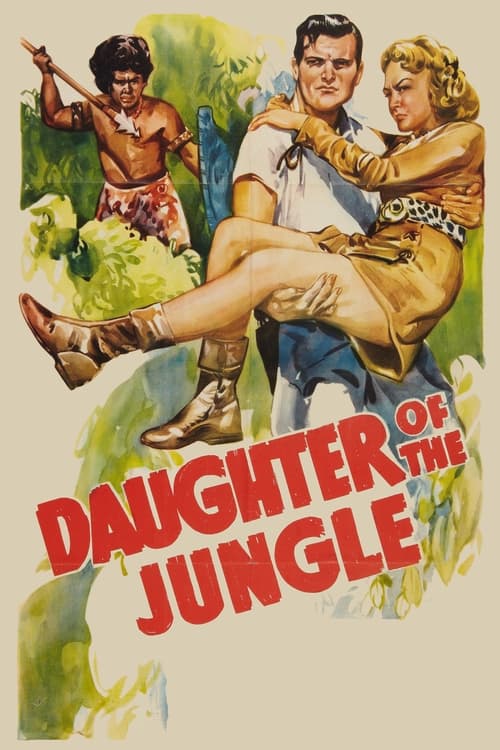
Daughter of the Jungle
Plot
An airplane carrying a pair of police officers escorting gangsters to prison crash-lands in the African jungle. They are rescued from an attack by savage natives by a white woman who appears out of nowhere, and it turns out she is a lost heiress who herself crash-landed in the jungle years before.
Get the Weekly Woke Watchlist
New and trending movies scored for woke bias, preachy messaging, and forced political themes — before you waste your evening.
No spam. One useful email per week.
Overall Series Review
Categorical Breakdown
The narrative places a white woman, the lost heiress, as the central hero who possesses superior knowledge of the jungle over the indigenous tribes who were born there. Native characters are universally depicted as 'savage,' 'hostile,' and a 'thin caricature,' with one identified by 'witch doctor face paint,' setting them up as undifferentiated antagonists. There is no critique of whiteness or discussion of systemic oppression; the film operates on a clear racial and civilizational hierarchy that favors the Western characters.
The entire plot centers on the goal of getting back to 'civilization' to claim a trust fund. Western culture, its law enforcement (the police), and its financial institutions (the inheritance) are framed as the prize and the ultimate destination. The jungle setting, as opposed to the home culture, is depicted as a 'dangerous landscape' full of 'hostile tribes' and 'fierce animals,' which aligns with a perspective of gratitude for order rather than civilizational self-hatred.
The main character, Ticoora, is a 'feisty' and 'Tarzan-like' jungle dweller, demonstrating an unusual level of physical competence and independence. However, her portrayal is inconsistent with the 'Girl Boss' trope, as she is noted as an 'anti-Sheena' who shows 'no true toughness,' screams when attacked, and needs a male hero to defend her after she is slapped by a gangster. The dynamic is one of traditional complementarity where the woman is capable yet ultimately reliant on male protection, with no anti-natal or anti-family messaging.
As a 1949 B-movie jungle adventure, the film adheres to a normative social structure. The plot focuses on survival, crime, and an inheritance. There is no presence of alternative sexual ideologies, deconstruction of the nuclear family, or lecturing on gender theory.
There is a brief conflict between Western 'superior white medicine' practiced by Ticoora’s father and the 'voodoo' of the local witch doctor, framing a conflict between a rational or Christian-aligned worldview and primitive paganism. The traditional religion of the West is not vilified; instead, the spiritual practices of the antagonists are cast as 'exotic lands and customs' associated with hostility and danger.
Get the Weekly Woke Watchlist
New and trending movies scored for woke bias, preachy messaging, and forced political themes — before you waste your evening.
No spam. One useful email per week.