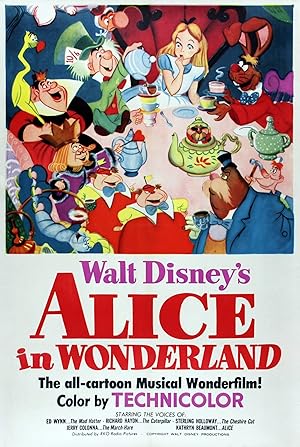
Alice in Wonderland
Plot
Alice is a daydreaming young girl. She finds learning poems and listening to literature boring. She prefers stories with pictures and to live inside her imagination. One day, while enduring just such a poetry reading, she spots a large white rabbit...dressed in a jacket and carrying a large watch. He scurries off, saying he's late, for a very important date. She follows him through the forest. He then disappears down a rabbit hole. Alice follows, leading her to all manner of discoveries, characters and adventures.
Get the Weekly Woke Watchlist
New and trending movies scored for woke bias, preachy messaging, and forced political themes — before you waste your evening.
No spam. One useful email per week.
Overall Series Review
Categorical Breakdown
The film does not engage with race, class, or intersectional theory. Casting is historically authentic to its Victorian setting. Character conflict is based on Alice's curiosity versus the madness of Wonderland's inhabitants. There is no depiction of white males as incompetent or evil; most characters are anthropomorphic animals or fantasy creatures whose merits are judged only by their individual eccentricities.
The movie opens with Alice finding a traditional poetry lesson boring, preferring her imagination. However, her dream-journey to Wonderland is not a lecture on the corruption of her home culture. Wonderland is depicted as utterly chaotic, nonsensical, and frightening, leading Alice to conclude that she must return to reality. This experience ultimately values the structure of the real world over the seductive chaos of an imagined one.
Alice is an independent, curious female lead who goes on an adventure for its own sake and does not seek a romantic partner. She is not a perfect 'Mary Sue' but rather a girl who is often frustrated and makes mistakes. Her sister and the Queen of Hearts are the other main female figures; the Queen is a tyrant, but her character is based on madness and power, not a critique of traditional female roles. There is no anti-natal or anti-family messaging.
The film's focus is on fantasy, whimsy, and nonsense. There is no presence of sexual ideology, alternative sexualities, or explicit deconstruction of the nuclear family. The nuclear family unit is shown as the stable starting point that Alice returns to at the end.
There is no overt hostility toward religion or Christianity. The world of Wonderland operates on pure moral and logical relativism (madness and nonsense), which is a characteristic of the dream-world itself, not a direct critique of a transcendent moral order. Morality is subjective in Wonderland but is not framed as a political 'power dynamic' lecture.
Get the Weekly Woke Watchlist
New and trending movies scored for woke bias, preachy messaging, and forced political themes — before you waste your evening.
No spam. One useful email per week.