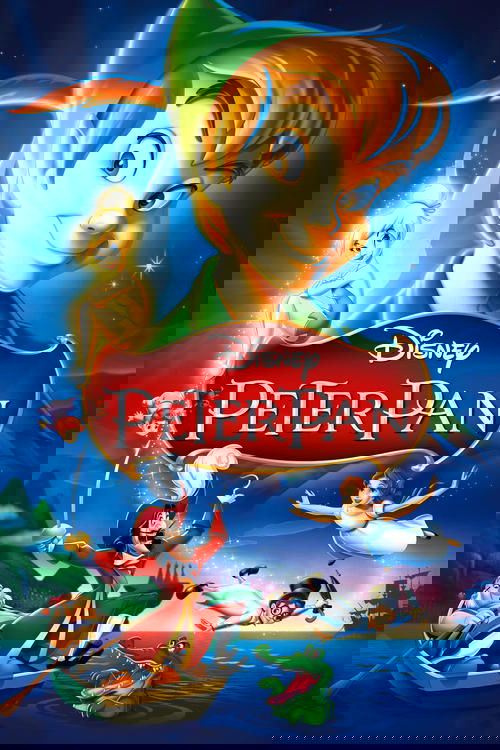
Peter Pan
Plot
Leaving the safety of their nursery behind, Wendy, Michael and John follow Peter Pan to a magical world where childhood lasts forever. But while in Neverland, the kids must face Captain Hook and foil his attempts to get rid of Peter for good.
Get the Weekly Woke Watchlist
New and trending movies scored for woke bias, preachy messaging, and forced political themes — before you waste your evening.
No spam. One useful email per week.
Overall Series Review
Categorical Breakdown
The film features extremely explicit and derogatory racial caricature through the depiction of the Neverland 'Indians,' who are referred to with slurs such as 'Injuns' and 'Redskins' by the white characters. An entire musical number, 'What Made the Red Man Red,' is dedicated to explaining the group's origin through exaggerated, offensive stereotypes. The narrative portrays them as a caricatured 'other,' reinforcing white superiority tropes, which is the antithesis of universal meritocracy. This content matches the 10/10 descriptor for relying on race and caricature rather than character merit.
The film ultimately champions the return to the Darling family's London nursery, framing the conventional Victorian home and its structure—complete with the mother, father, and siblings—as the desirable and protective shield against chaos and arrested development. Neverland is a place of anarchic immaturity, not a spiritually superior culture, which contradicts the 'Noble Savage' or civilizational self-hatred trope. The presence of the Native caricature, while racist, serves as an 'exotic other' rather than a superior culture designed to demonize the West. The movie is a testimonial to the strength of the traditional family institution.
The core dynamic of the female characters, especially Wendy, is defined by traditional, complementary gender roles. Wendy’s primary function in Neverland is to be a mother figure, sewing, cleaning, and telling stories to the Lost Boys, which aligns with the 'Cult of True Womanhood' ideal. The other major female character, Tinker Bell, is overwhelmingly portrayed as jealous and emotional, an element Hook exploits by telling her that the other woman is to blame for her issues. The film celebrates motherhood as the proper path for the female character, contrasting with the 'Girl Boss' and anti-natalism tropes.
The narrative adheres to a normative structure, centering the traditional Darling nuclear family as the ideal. The entire plot resolves with the children returning to their male-female parents. The characters' internal conflicts and motivations are not based on sexual identity or gender ideology. Peter Pan's refusal to grow up is a theme of childishness and avoidance of responsibility, not a commentary on biological reality or gender theory.
The film is a fantasy-adventure focused on childhood and imagination, and it is largely devoid of explicit religious themes or figures. The primary moral conflict is a straightforward, transcendent 'good versus evil' dynamic between Peter Pan and Captain Hook. The villains are pirates, not religious or moral relativists. There is no open hostility toward religion, nor is there a lecture on morality being subjective power dynamics, though the morality itself is non-Christianity specific.
Get the Weekly Woke Watchlist
New and trending movies scored for woke bias, preachy messaging, and forced political themes — before you waste your evening.
No spam. One useful email per week.