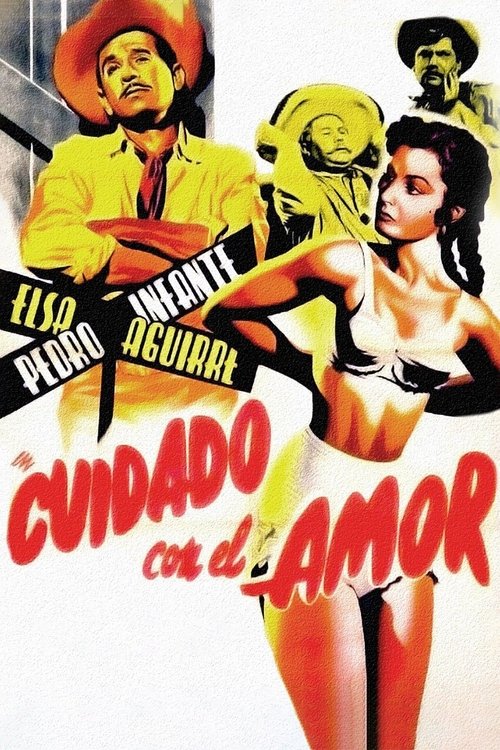
Cuidado con el amor
Plot
Salvador accompanied by two friends of his father whom he calls uncles, they arrive at a fair in the village, there he meets Ana. When he wins a bet he is paid with a mortgaged house, to his surprise upon entering the hom he realizes that Ana and her mother live in it, provoking a funny entanglement with an explosive final.
Get the Weekly Woke Watchlist
New and trending movies scored for woke bias, preachy messaging, and forced political themes — before you waste your evening.
No spam. One useful email per week.
Overall Series Review
Categorical Breakdown
The film focuses on a comedic, romantic rivalry set within Mexican rural tradition. Character identities are not viewed through an intersectional lens. The narrative is driven by classic comedic plotting—a man acquiring a property that a woman inhabits—not by race, privilege, or a vilification of any immutable characteristic. All casting is culturally authentic to the time and place of the Mexican Golden Age cinema, operating on a principle of universal meritocracy within the story's context.
As a 'comedia ranchera,' the film is a celebration of Mexican culture, music, and rural life. The tone is deeply appreciative of local traditions, humor, and community, with 'gratas canciones' (pleasing songs) that are a reference to Mexican musical culture. The content is the opposite of civilizational self-hatred, acting instead as a cultural touchstone that respects its home and ancestors.
The female lead, Ana, is described as 'indomable' (untamed/indomitable) and plays with the male protagonist's feelings. This suggests a strong, spirited woman who is an equal match and challenger to the iconic male lead. This complexity keeps the score low, as the male is not emasculated and the goal of the plot is traditional male-female pairing. There is no evidence of anti-natalism; motherhood is present and respected through Ana's mother.
The film adheres to the normative structure of a 1950s romantic comedy. The entire premise is built upon the central pairing of the male and female lead, Salvador and Ana. There is no inclusion or centering of alternative sexualities, no deconstruction of the nuclear family, and no discussion of gender ideology. Sexuality is treated as a private matter that leads to the traditional resolution.
The film belongs to a genre that traditionally incorporates themes of faith, family, and tradition as shields against chaos. The setting is a traditional Mexican village, and morality is based on an assumed objective truth common to the culture and time. There is no hostility toward religion and no embrace of moral relativism; the conflict is romantic and situational, not spiritual or ideological.
Get the Weekly Woke Watchlist
New and trending movies scored for woke bias, preachy messaging, and forced political themes — before you waste your evening.
No spam. One useful email per week.