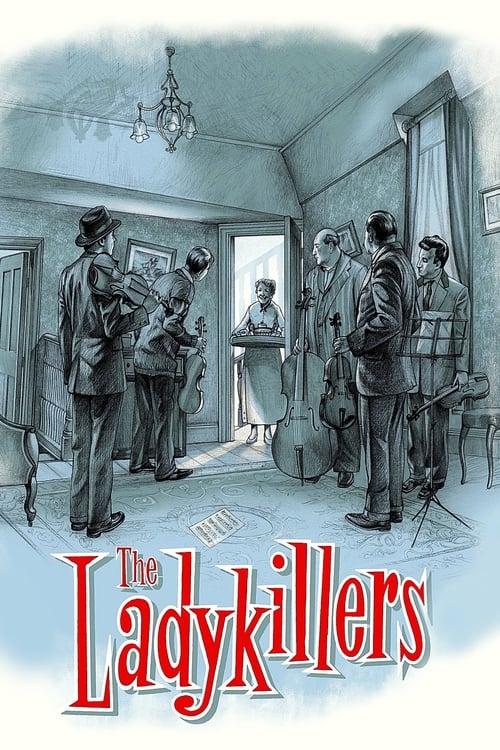
The Ladykillers
Plot
Five oddball criminals planning a bank robbery rent rooms on a cul-de-sac from an octogenarian widow under the pretext that they are classical musicians.
Get the Weekly Woke Watchlist
New and trending movies scored for woke bias, preachy messaging, and forced political themes — before you waste your evening.
No spam. One useful email per week.
Overall Series Review
Categorical Breakdown
Characters are judged entirely by their criminal intent or moral fiber, not their immutable characteristics. All main characters are white, reflecting the 1950s British setting, with no racial or intersectional commentary or forced diversity. The plot concerns the conflict between a criminal gang and an innocent landlady.
The setting, Mrs. Wilberforce's dilapidated Victorian house, is interpreted as a symbol of 'decrepit England' clinging to the past. The film offers a light satire on the inefficiency and stasis of the home culture. However, the traditional values embodied by the old woman are ultimately presented as a force of moral resilience that defeats the cynical, modern criminal enterprise, not as fundamentally corrupt or racist.
The female lead, Mrs. Wilberforce, is the moral and physical obstacle that utterly defeats the five male criminals. She is portrayed as possessing a superior moral character and ultimately out-competes the men. Her strength, however, comes from her 'confidently Victorian' and old-fashioned values, which counters the anti-natalist 'Girl Boss' definition, but the men are certainly shown as bumbling and evil in comparison to her.
The film focuses entirely on a crime caper and the conflict between the gang and the landlady. The narrative features normative structure, with the nuclear family and traditional male-female pairing as the assumed societal default. There is no presence of alternative sexual ideology or gender theory lecturing.
The film centers on the triumph of an objective moral law over an amoral, greedy criminal element. Mrs. Wilberforce embodies '19th-century certainties' and a formidable old-fashioned virtue. The narrative rewards moral truth and innocence, offering no hostility toward religion or an embrace of moral relativism; the gang's downfall is a direct result of their depraved morality.
Get the Weekly Woke Watchlist
New and trending movies scored for woke bias, preachy messaging, and forced political themes — before you waste your evening.
No spam. One useful email per week.