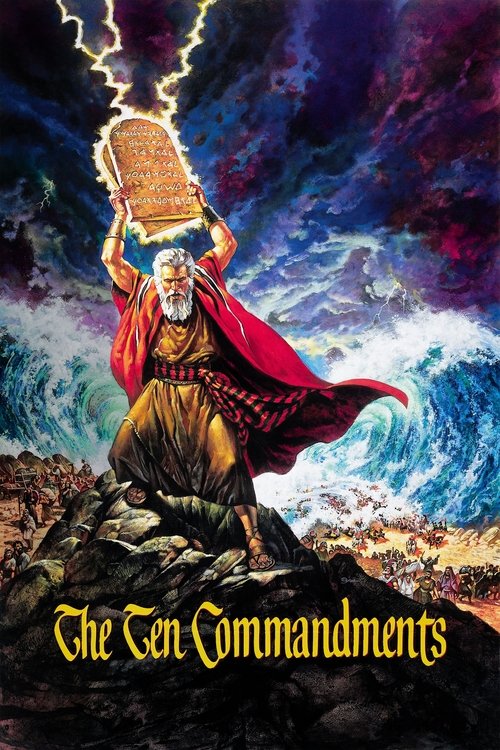
The Ten Commandments
Plot
Escaping death, a Hebrew infant is raised in a royal household to become a prince. Upon discovery of his true heritage, Moses embarks on a personal quest to reclaim his destiny as the leader and liberator of the Hebrew people.
Get the Weekly Woke Watchlist
New and trending movies scored for woke bias, preachy messaging, and forced political themes — before you waste your evening.
No spam. One useful email per week.
Overall Series Review
Categorical Breakdown
The central plot is based on the immutable characteristic of Moses’ Hebrew bloodline, which drives the liberation of his oppressed people from Egyptian slavery. This is a story of systemic oppression based on birthright. However, characters, including Moses, are ultimately judged and elevated based on moral fortitude and divine merit, not solely group identity. The casting uses white Hollywood actors in all major ancient Egyptian and Hebrew roles, which is a mid-20th-century industry standard and not a modern political 'race-swapping' for the purpose of vilifying 'whiteness.'
The narrative explicitly champions a foundational Western/Judeo-Christian concept: that the law of God is the essential bedrock of human freedom, contrasting this with the brutal, tyrannical, and pagan Egyptian empire. The film's subtext positions the Hebrews' pursuit of liberty against the absolute power of the Pharaoh as an analogy for the Cold War struggle against atheistic communism. The institutions of the family unit, nation, and faith are presented as protective forces against chaos and state oppression.
The gender roles are entirely traditional and complementary. The main male characters are strong, decisive leaders, protectors, and lawgivers. The major female characters are either a devoted, supportive wife and mother (Sephora) or a figure whose intense ambition for political power and lust makes her a tragic, destructive catalyst for the male characters (Nefretiri). Motherhood, exemplified by Moses' biological mother Yochabel and adoptive mother Bithiah, is treated with deep reverence and is central to the hero's survival and destiny.
The film focuses exclusively on traditional male-female pairings and the establishment of the nuclear family through marriage (Moses/Sephora, Joshua/Lilia). The narrative follows the normative structure of the biblical text without incorporating any contemporary sexual or gender ideology, centering sex and romance as private aspects of the hero's life and destiny.
The entire story is a declaration of objective, transcendent moral law received from God, which directly combats the subjective 'power dynamics' philosophy of the Egyptian Pharaoh. Faith in a higher power is explicitly the source of the hero's strength and the ultimate victory of freedom over tyranny. The film is a pro-faith epic where God is the supreme force of justice and moral truth.
Get the Weekly Woke Watchlist
New and trending movies scored for woke bias, preachy messaging, and forced political themes — before you waste your evening.
No spam. One useful email per week.