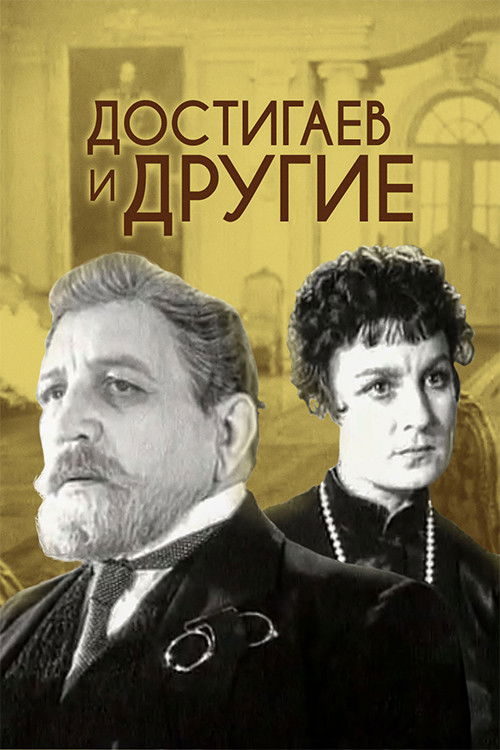
Dostigayev and Others
Plot
July-December 1917, the country is undergoing a revolution. "The pillars of society" are alarmed by the looming on them menacing events. Some of them are ready to fight with the revolution, others — among them industrialist Vasily Dostigaev trying to "adapt»
Get the Weekly Woke Watchlist
New and trending movies scored for woke bias, preachy messaging, and forced political themes — before you waste your evening.
No spam. One useful email per week.
Overall Series Review
Categorical Breakdown
The narrative's central conflict relies entirely on class-based identity politics. The Bourgeoisie/Capitalists, represented by Vasily Dostigaev and the 'pillars of society,' are depicted as a fundamentally flawed, morally corrupt, and doomed class defined solely by their privilege. The plot exists to demonstrate the systemic oppression of the working class (the Proletariat) and justify the overthrow of the old social hierarchy, which is the Marxist equivalent of intersectional lecture on privilege.
The film's entire purpose is the hostile critique of Imperial/Tsarist Russia and its institutions. The 'Western home culture' in this context is the Russian Empire, which is framed as fundamentally corrupt and collapsing. The ancestors and the old social order are demonized as selfish and irredeemably flawed, justifying their destruction in favor of the new Soviet civilization. The depiction of the elite's alarm is an act of celebrating the destruction of the old regime.
As a Socialist Realist work, the film likely portrays female characters from the Bourgeoisie as decadent, idle, or politically naive, contrasting them with the strong, revolutionary female archetype (even if not explicitly shown as 'girl bosses' in a Western sense). The ideological framework mandates that women of the old regime be shown as products of a repressive, anti-fulfilling system, while the new order offers superior, purpose-driven fulfillment that prioritizes the collective political struggle over traditional family roles.
The Soviet Union in 1959 was a highly restrictive, traditional, and explicitly anti-homosexual society where 'queer theory' was nonexistent in media and would have been politically impossible. The film adheres to a strict, normative male-female structure, with no centering of alternative sexualities or deconstruction of the nuclear family being presented as an option for the protagonists or antagonists.
The core Marxist framework of the film treats traditional religion (Russian Orthodox Christianity) as an opiate for the masses and a political tool of the ruling class. Dialogue suggests the 'pillars of society' are attempting to use the election of a patriarch as a way to impose 'order' in the absence of a secular leader, framing faith not as a source of strength or transcendent morality, but as a cynical instrument of political control for the dying elite.
Get the Weekly Woke Watchlist
New and trending movies scored for woke bias, preachy messaging, and forced political themes — before you waste your evening.
No spam. One useful email per week.