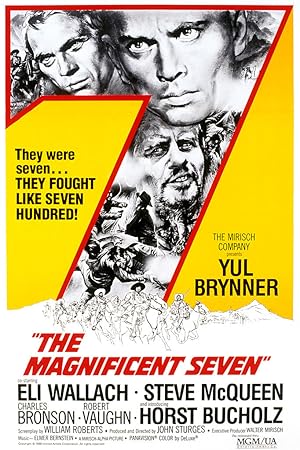
The Magnificent Seven
Plot
A bandit terrorizes a small Mexican farming village each year. Several of the village elders send three of the farmers into the United States to search for gunmen to defend them. They end up with seven, each of whom comes for a different reason. They must prepare the town to repulse an army of thirty bandits who will arrive wanting food.
Get the Weekly Woke Watchlist
New and trending movies scored for woke bias, preachy messaging, and forced political themes — before you waste your evening.
No spam. One useful email per week.
Overall Series Review
Categorical Breakdown
Characters are judged by their skill with a gun and their willingness to fight, embodying a principle of universal meritocracy. The movie opens with the main hero intervening to ensure a Native American is buried, challenging the prejudice of the local white townspeople. However, the plot structure of predominantly white gunmen saving a passive non-white village is often critiqued today as a 'White savior' narrative, which slightly increases the score from the lowest possible rating.
The film does not promote civilizational self-hatred. The heroes are drifters from the American West, but their actions are portrayed as noble and courageous, finding honor in protecting a simple, agrarian community. The American town seen early on is depicted as prejudiced and cowardly, but this is a critique of a specific moral failure, not a demonization of the entire Western home culture. The final message respects the rooted life of the villagers over the rootless life of the gunfighters.
The movie is heavily male-centric, focusing on the distinct competencies of the seven male gunfighters. The women in the village are passive figures initially hidden out of fear, and there are no 'Girl Boss' or 'Mary Sue' characters. The main romantic subplot concludes with the young gunfighter abandoning his career to marry a village woman and settle down, directly celebrating a traditional, natalist, family-focused life.
The film contains no themes or characters related to LGBTQ+ ideology or gender theory. The narrative is focused on action, traditional male roles, and a conventional heterosexual romance. The structure is entirely normative with regard to gender and sexuality.
There is no overt hostility toward religion. The conflict is a simple, objective moral struggle between the courageous defenders (good) and the murderous bandits (evil). The morality is transcendent, dealing with themes of sacrifice and justice, rather than subjective power dynamics. The secular nature of the gunslingers’ motivation is not an attack on the villagers' presumed faith.
Get the Weekly Woke Watchlist
New and trending movies scored for woke bias, preachy messaging, and forced political themes — before you waste your evening.
No spam. One useful email per week.