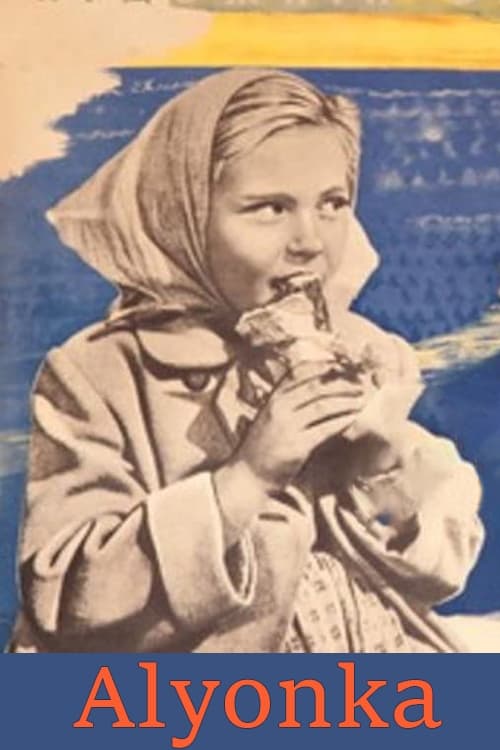
Alyonka
Plot
Set in 1955 when many migrated from Russia to the Steppes of Kazakhstan, this is the trip back to the Canal from the frontier and farms by a number of people who tell their settler stories. Alenka Muratova (Ovodova) is a winsome 13 year old who talks Dmitry Prokovich, the chief mechanic for the Soviet, into giving up his seat in the truck to a young mother with her infant daughter. Then Alenka and Dmitry share the back of the open truck with a young woman, newly graduated dentist who has not been able to find a position, Stefan, a hitchhiker with a dog who hopes his upper-class wife will return to him and the countryside, and Vasselina Petrovolka, a woman who lost one of her twin daughters in a riding accident by the river shortly after they arrived, and now is returning to tell the other twin of her sister's fate. A warm hearted look at common folks traveling in the frontier.
Get the Weekly Woke Watchlist
New and trending movies scored for woke bias, preachy messaging, and forced political themes — before you waste your evening.
No spam. One useful email per week.
Overall Series Review
Categorical Breakdown
The narrative focuses entirely on the stories of Soviet settlers and their common humanity during a state-led movement, not on race or immutable characteristics. Characters are defined by their merit, their actions, and their individual struggles within the collective system. There is no evidence of vilification of 'whiteness' or forced diversity; the casting is authentic to the historical context of the Russian/Soviet population involved in the Virgin Lands Campaign.
The film does not exhibit self-hatred toward Western civilization, as it is a product of Soviet cinema. The film's context is an internal critique of the Soviet system’s bureaucracy and collective farm life. The core theme is a tribute to the ‘brave souls’ who relocated, showing respect for the settlers’ sacrifice and aspirations. The setting is framed with epic grandeur, suggesting respect for the home (Soviet) territory and the people building a life there.
Female characters like Alyonka, the young protagonist, are active, outspoken, and intelligent. The young dentist shows initiative by traveling to secure her own equipment. Another female character, Lida, is criticized for her boredom with the collective life, which nearly leads to her death, suggesting that an anti-family or anti-communal mindset is detrimental. While women are not passive, the narrative does not present 'perfect' Mary Sues nor does it consistently emasculate the male characters; men like the chief mechanic are portrayed as kind and helpful. The film portrays distinct but complementary roles within the frontier setting, though female competence is highlighted.
The film focuses on traditional male-female pairing, marriage, and family life in the context of the Soviet frontier. There is no presence of alternative sexual ideologies, deconstruction of the nuclear family, or discussions of gender theory. Sexuality remains private and a non-central theme to the character's core struggles.
The film is a product of the Soviet Union, a state-atheist regime, meaning a transcendent, Christian-based morality is absent by default. The morality is instead framed within the context of communal Soviet ideals—collectivism, common decency, and helping one another—rather than explicitly subjective 'power dynamics.' There is no overt, active vilification of religion, but the narrative does not find strength in faith or acknowledge objective spiritual truth above the collective good, which moves the score above the floor of '1'.
Get the Weekly Woke Watchlist
New and trending movies scored for woke bias, preachy messaging, and forced political themes — before you waste your evening.
No spam. One useful email per week.