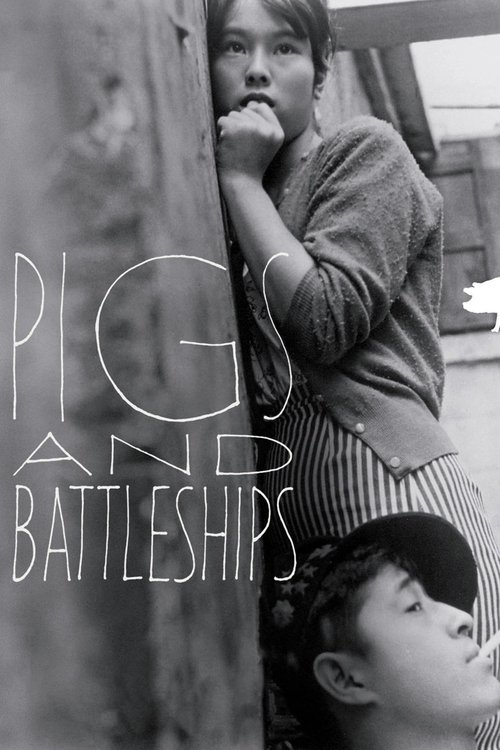
Pigs and Battleships
Plot
In the city of Yokosuka, Kinta and his lover Haruko, both involved with yakuza, brave the post-occupation period with a goal to be together.
Get the Weekly Woke Watchlist
New and trending movies scored for woke bias, preachy messaging, and forced political themes — before you waste your evening.
No spam. One useful email per week.
Overall Series Review
Categorical Breakdown
The core conflict does not use an intersectional lens; it is an economic and national critique. American soldiers are presented as boorish, drunken, and a source of corruption, representing an imperial/foreign influence rather than vilifying 'whiteness' in a modern, systemic privilege context. The film's primary focus is on the character merit—or lack thereof—of the Japanese protagonists.
The film acts as a powerful, savage indictment of the nation's identity and moral decay during the post-war era. The Japanese people are represented by pigs, an allegorical term for moral corruption, greed, and the national willingness to live off 'scraps' from the occupying power. This presents the home culture and its new identity as fundamentally corrupt and morally base, which aligns with the spirit of civilizational self-hatred.
The female lead, Haruko, is depicted as the intellectual and moral superior of the male characters, a tenacious and pragmatic figure who rejects the easy, corrupt money and life of a 'kept woman.' The male lead and all other yakuza men are shown as bumbling, naive, or entirely corrupt, creating a strong contrast where masculinity is mostly incompetent or toxic. However, Haruko's ultimate aspiration remains the traditional goal of marriage and family, which keeps the score from the highest 'anti-natal' rating.
The narrative revolves entirely around traditional male-female relationships, albeit often transactional and corrupt. There is no presence of alternative sexualities, gender ideology, or a critique of the nuclear family structure using a queer theory lens. Sexuality is depicted as a private, if commercially exploited, matter.
The movie operates within a profound moral vacuum where characters are driven solely by material greed, money, and self-interest. This environment suggests a world without transcendent morality or objective truth. However, the film avoids direct hostility toward or criticism of organized religion, specifically Christianity, as the source of the chaos. The corruption is shown as political, economic, and moral, rather than anti-theistic.
Get the Weekly Woke Watchlist
New and trending movies scored for woke bias, preachy messaging, and forced political themes — before you waste your evening.
No spam. One useful email per week.