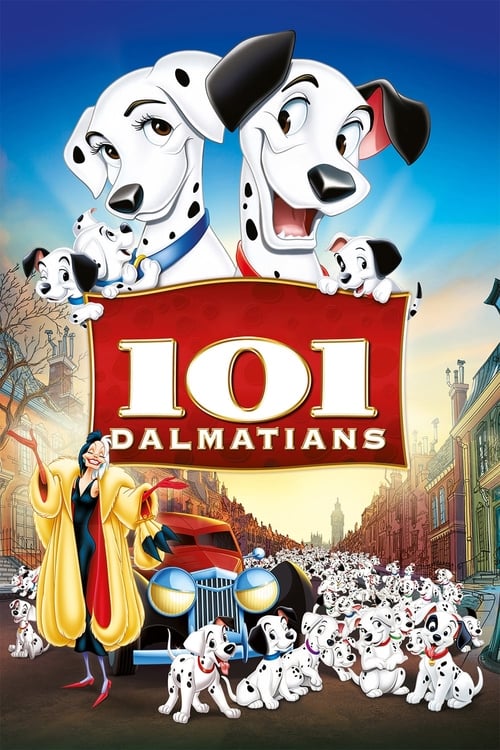
One Hundred and One Dalmatians
Plot
When a litter of dalmatian puppies are abducted by the minions of Cruella De Vil, the parents must find them before she uses them for a diabolical fashion statement.
Get the Weekly Woke Watchlist
New and trending movies scored for woke bias, preachy messaging, and forced political themes — before you waste your evening.
No spam. One useful email per week.
Overall Series Review
Categorical Breakdown
The narrative makes no use of race or immutable characteristics to determine character value; all human characters are white, reflecting the 1960s London setting. The villain's motivation is purely materialistic greed for a fur coat, not systemic oppression or privilege. The moral alignment is based solely on the content of the soul, where the humble, loving family stands against the wealthy, selfish heiress.
The film functions as a celebration of the nuclear family and home life, which is consistently framed as a warm, protective, and desirable institution. The protagonists are trying to save their children and return them to their home. The 'Twilight Bark' sequence reinforces the power of a widespread, inter-species community working together for a common, protective cause. There is no demonization of the home culture or ancestors.
The core female characters, Perdita and Anita, are celebrated for their roles as protective mothers and wives, strongly affirming motherhood as a source of fulfillment. The female antagonist, Cruella De Vil, is an eccentric, career-obsessed heiress who is depicted as the epitome of destructive evil and anti-natalism (desiring to destroy life for a superficial object). Masculinity is protective, as Pongo initiates the rescue and Roger stands up to Cruella, while women, like Anita and Nanny, are integral to the family's defense and care.
The story is exclusively centered on the heterosexual pairing of Roger and Anita and the animal couple Pongo and Perdita, whose success in forming a traditional nuclear family is the foundation of the entire plot. There is no presence of alternative sexualities, deconstruction of the nuclear family, or introduction of gender ideology.
The conflict is one of objective moral law—good versus absolute evil (represented by Cruella's name, 'Devil'). The narrative presents a clear, transcendent moral truth that the value of life (the puppies) is infinitely greater than material possessions (a fur coat). The film does not feature religion, but the moral framework is founded on universally recognizable, non-subjective good and evil.
Get the Weekly Woke Watchlist
New and trending movies scored for woke bias, preachy messaging, and forced political themes — before you waste your evening.
No spam. One useful email per week.