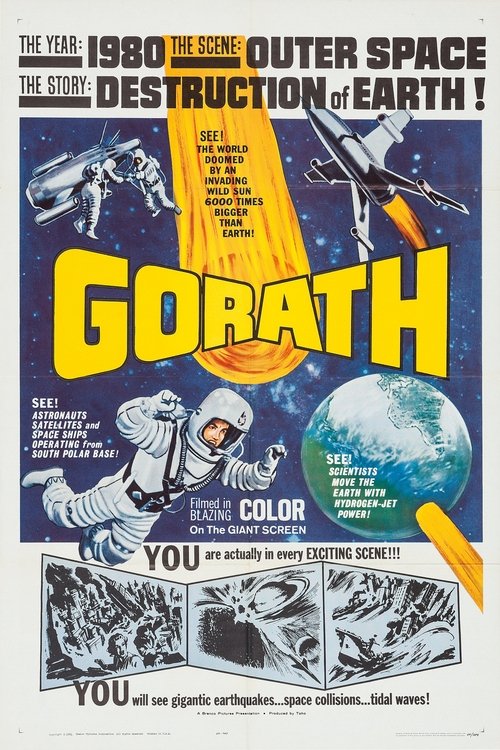
Gorath
Plot
In 1976, a drifting star named Gorath is discovered to be on a collision course with Earth. Although it is smaller than Earth, its enormous mass is enough to destroy the planet totally. A mission sent to observe Gorath is destroyed after the ship is drawn into the star, with a later mission barely escaping the same fate. However, Astronaut Tatsuma Kanai is left in a catatonic state due to his near death experience. Unable to destroy the invading star, Earth's scientists undertake a desperate plan to build giant rockets at the South Pole to move the planet out of Gorath's path before it is too late.
Get the Weekly Woke Watchlist
New and trending movies scored for woke bias, preachy messaging, and forced political themes — before you waste your evening.
No spam. One useful email per week.
Overall Series Review
Categorical Breakdown
The narrative focuses on universal meritocracy and scientific competence, not on immutable characteristics or race. The threat requires global cooperation, directly contrasting with a focus on intersectional conflict. Personnel are judged by their capability to solve the world-ending crisis.
The entire plot is dedicated to saving Earth and human civilization, which aligns with the core principle of 'Gratitude & Chesterton’s Fence.' The world's nations unite to protect their home and ancestors' sacrifices, not to demonize them.
Female characters hold professional roles, such as an astronomer and a prime minister's secretary, which gives them a measure of competence in the crisis. However, some female roles are noted in commentary as being largely for romantic interest or visual appeal, not as an effort to emasculate men or promote a 'Girl Boss' ideology. There is no anti-natalist or anti-family messaging.
The story is a disaster epic focused on a celestial collision. The narrative adheres to a normative structure, with no element of alternative sexualities, deconstruction of the nuclear family, or focus on sexual or gender identity as a political statement.
The film’s solution to the crisis is entirely secular and technological, involving science, engineering, and political will. Faith is not presented as a central source of strength, but neither is traditional religion demonized or portrayed as the root of evil. The morality is transcendent in the objective sense of saving humanity, a goal all characters pursue equally.
Get the Weekly Woke Watchlist
New and trending movies scored for woke bias, preachy messaging, and forced political themes — before you waste your evening.
No spam. One useful email per week.