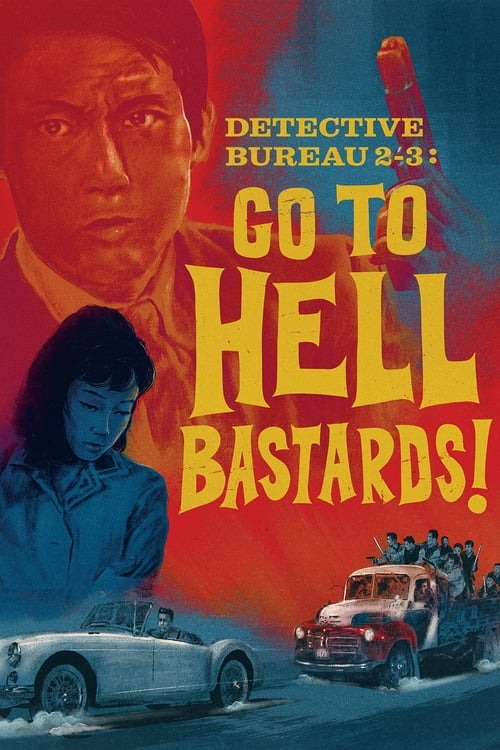
Detective Bureau 2-3: Go to Hell, Bastards!
Plot
Tajima is a private detective in charge of his own company, Detective Bureau 2-3. When warring criminal gangs go overboard by robbing U.S. military munitions, Tajima steps in to stop what the cops can't.
Get the Weekly Woke Watchlist
New and trending movies scored for woke bias, preachy messaging, and forced political themes — before you waste your evening.
No spam. One useful email per week.
Overall Series Review
Categorical Breakdown
The narrative centers on a singular, highly competent male protagonist, Tajima, whose success is based entirely on his individual skill, courage, and intelligence. The conflict is a crime procedural between ethnically homogeneous Japanese characters (police vs. yakuza) and features no emphasis on race, class, or any intersectional hierarchy. Character value is judged by their loyalty or criminality, consistent with a universal meritocracy.
The movie is set in a post-war Japan that is rapidly modernizing and Westernizing, with themes criticizing the post-war greed and organized crime that exploits the presence of U.S. arms. This criticism is aimed at the corruption and the negative consequences of cultural change and foreign influence, but the film concludes with the hero enjoying 'rebuilding boom-era Japan,' affirming a future for the nation and respecting the drive for national prosperity. The primary hostility is toward internal criminals and not a fundamental civilizational self-hatred.
Gender dynamics are strictly traditional and pre-feminist. The female lead, Chiaki, is introduced as the boss’s mistress, a victim figure who is eventually 'saved' by the male hero, Tajima, and then becomes his romantic interest and employee. She is a prize and a companion. She is not a 'Girl Boss' or a flawless Mary Sue. The film even features a scene of rough, coercive male behavior played for dark comedy, strongly placing the film in the 1/10 category of traditional, complementary, and protective masculinity.
The core relational dynamic is a traditional, explicitly heterosexual pairing. The story's focus on the female lead's virginity, due to her gang boss being impotent, reinforces a normative structure and a focus on traditional sexual roles and status. There is no presence of queer theory, alternative sexualities are not centered, and the nuclear family is not a topic of discussion for deconstruction.
The movie is secular in its primary theme of crime and detection. Religion, specifically a Catholic church and a fake priest father, is only used as a functional part of the protagonist's undercover cover story, which the police successfully corroborate. This suggests religion is viewed as a source of respectability or a useful social institution, rather than a source of evil or bigotry. An irreverent musical number involving a spiritual song is present, but it functions more as stylistic pop-culture flair than a deliberate attack on faith or morality.
Get the Weekly Woke Watchlist
New and trending movies scored for woke bias, preachy messaging, and forced political themes — before you waste your evening.
No spam. One useful email per week.