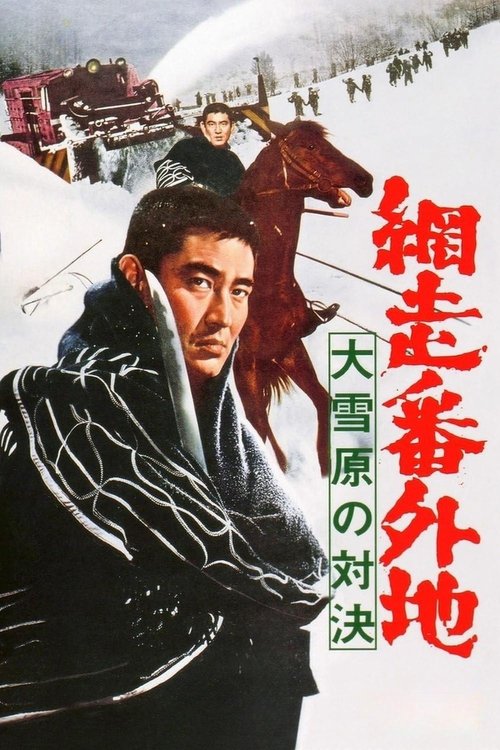
Abashiri Prison: Duel in the Snow Country
Plot
Based on Ito Hajime's original story, this is the seventh installment in the "Bangaichi" series, adapted jointly by Kamba Fumio and Matsuda Hiroo, and directed by Ishii Teruo of "Kamba 101: Killing Bouncer" fame. The film was shot by Kiichi Inada, who also directed "Abashiri Bangaichi: Confrontation in the South" in the same series.
Get the Weekly Woke Watchlist
New and trending movies scored for woke bias, preachy messaging, and forced political themes — before you waste your evening.
No spam. One useful email per week.
Overall Series Review
Categorical Breakdown
The movie operates entirely outside the lens of intersectionality, focusing on criminal hierarchy, individual character, and merit—or lack thereof—in an outlaw society. The conflict is based on personal honor and action, not immutable characteristics. The casting is entirely Japanese and historically authentic to the setting of a 1960s Hokkaido prison and Yakuza underworld.
The movie is a celebration of a uniquely Japanese genre (Ninkyo Eiga or 'chivalry film') and national archetypes. It showcases the raw beauty and difficulty of the Japanese landscape in Hokkaido, which serves as a powerful backdrop for testing the protagonist's resilience. The narrative focuses on an internal criminal/systemic conflict, showing no hostility toward Japanese civilization, its culture, or its ancestors.
The film is deeply rooted in a male-centric genre (Yakuza/prison drama) and features a male archetype, the *ninkyo* or honorable gangster. Women are typically relegated to minor or supportive roles, such as the protagonist's ailing mother or the gangster's moll. This gender dynamic is complementary and traditional, featuring protective masculinity rather than any 'Girl Boss' tropes or anti-natalist themes. The absence of female leads or power structures keeps the score very low.
As a film from 1966, there is no centering of alternative sexualities or promotion of queer theory. However, one of the previous installments in the series is noted in contemporary commentary to feature a gay couple for 'spoofy' humor. If a similar element is present, it is for a brief comedic beat that treats the relationship as a joke or a deviation from the norm, confirming a normative structure but acknowledging a non-ideological, comedic presence.
The movie is set in a culture where themes of loyalty, honor, and duty are paramount, often touching on traditional, transcendent moral codes common to the Yakuza genre. The narrative contains no elements of hostility toward religion and does not feature Christian characters as bigots or villains. Morality is framed as a matter of personal code and loyalty, reflecting a transcendent morality even within a criminal context.
Get the Weekly Woke Watchlist
New and trending movies scored for woke bias, preachy messaging, and forced political themes — before you waste your evening.
No spam. One useful email per week.