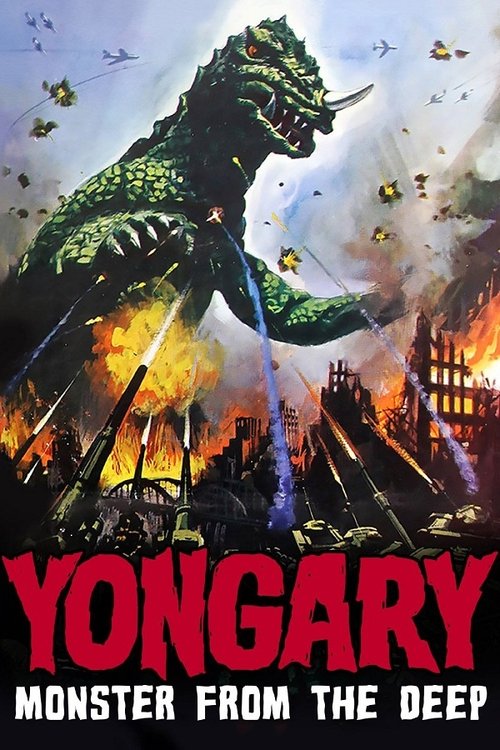
Yongary, Monster from the Deep
Plot
Earthquakes in central Korea turn out to be the work of Yongary, a prehistoric gasoline-eating reptile that soon goes on a rampage through Seoul.
Get the Weekly Woke Watchlist
New and trending movies scored for woke bias, preachy messaging, and forced political themes — before you waste your evening.
No spam. One useful email per week.
Overall Series Review
Categorical Breakdown
The narrative is focused on national survival and scientific ingenuity in South Korea. Characters are judged solely on their ability to contribute to solving the monster crisis, embodying universal meritocracy. The cast is culturally authentic for a South Korean production, and there is no evidence of forced diversity, race-swapping, or vilification of any specific race.
The film acts as a response to the monster genre, specifically imagining a futuristic and self-reliant Republic of Korea. While the monster destroys the capital city, the destruction of the former Japanese General Government Building is interpreted as a critique of Japanese colonial rule and the current dictatorial government, not an attack on the foundational values of South Korean culture or its ancestors. The core theme is the defense of the nation from an external, scientifically-generated threat.
The human story centers on the scientist Illo and the child protagonist Icho as the primary actors of change, with Icho's accidental discovery leading to the monster's weakness. The plot features a traditional family unit, with Illo and his girlfriend Soona's relationship and the family dynamic being central to the human element. Masculinity is explicitly portrayed as being tested and proven through the male characters' actions. There is no 'Girl Boss' trope or anti-natalist messaging.
The core human relationships are defined by a traditional male-female pairing between the scientist and his girlfriend, which is typical of its 1960s production era. The narrative presents a normative family structure. The film does not feature or lecture on alternative sexualities, gender ideology, or the deconstruction of the nuclear family.
The monster's origin is tied to a nuclear test, placing the central conflict firmly within the realm of science and military response, though the monster is named after a Korean fable. The film's morality is objective, demanding the monster's destruction to save human life. There is no presence of anti-religious rhetoric or a spiritual vacuum where morality is subjective; the threat is real and must be defeated by human effort.
Get the Weekly Woke Watchlist
New and trending movies scored for woke bias, preachy messaging, and forced political themes — before you waste your evening.
No spam. One useful email per week.