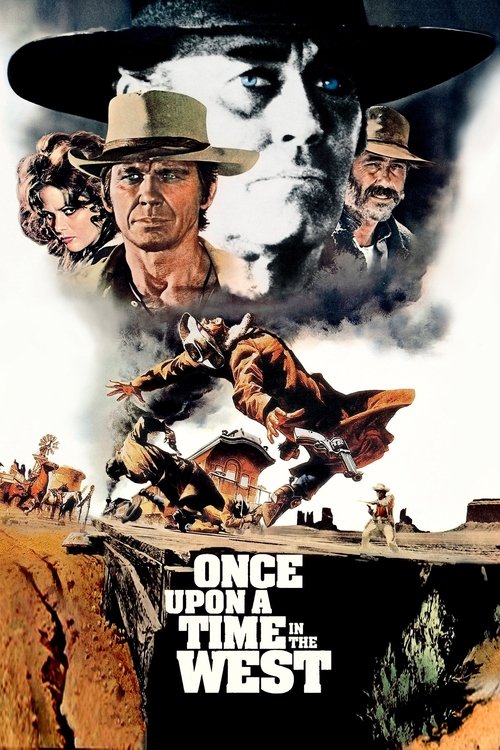
Once Upon a Time in the West
Plot
As the railroad builders advance unstoppably through the Arizona desert on their way to the sea, Jill arrives in the small town of Flagstone with the intention of starting a new life.
Get the Weekly Woke Watchlist
New and trending movies scored for woke bias, preachy messaging, and forced political themes — before you waste your evening.
No spam. One useful email per week.
Overall Series Review
Categorical Breakdown
The film does not lecture on privilege or systemic oppression based on race. Characters are judged by their actions, not their immutable characteristics. The villain is a white male industrialist, and the heroes are two white male outlaws and a white female former prostitute. Some cultural commentary suggests the character Harmonica may be intended by the director to be of Native American descent, based on the non-Caucasian appearance of the boy in the flashback, but the adult actor is Charles Bronson, resulting in a kind of historical 'race-swapping' ambiguity that is not explicitly central to the narrative’s theme.
The film is fundamentally a 'revisionist' Western that serves as a 'eulogy' for the genre and the Old West era. The core theme is the 'death of the West,' framed as the end of a heroic, albeit violent, 'ancient race' of men (the gunfighters) who are replaced by the corrupt, non-heroic forces of modern American capitalism (the railroad industrialist). This deconstruction frames the heritage of the Wild West as a dying, anachronistic world that is about to be consumed by a new, equally ruthless but less honorable, form of civilization.
The main female protagonist, Jill, is an ex-prostitute who inherits a pivotal piece of land, making her a powerful and central figure in the story, surviving where the men of the old guard perish. The director himself noted that the arrival of the railroad 'ushers in the beginning of a world without balls,' suggesting a thematic shift toward the feminine. While Jill is a strong character who holds her own, she is also subjected to violence and sexual intimidation that is period-realistic for the harsh environment, preventing a 'Mary Sue' or completely 'Girl Boss' portrayal. The ending celebrates her role in establishing a home, not rejecting it for a career.
The film contains no elements of modern sexual or gender ideology. The focus is entirely on the traditional heterosexual dynamics of the Western genre, centered on the characters' quest for land, money, and revenge. The concept of the nuclear family is challenged by Frank’s murder of a family and Jill's non-traditional role, but the film does not employ any 'Queer Theory' lens or political lecturing.
Religion is not a factor in the film’s moral or dramatic structure. The characters' morality is secular and driven by clear, objective principles of revenge, honor, greed, and pragmatic self-interest. There is no explicit hostility toward organized religion or Christianity, but also no indication of transcendent morality as a source of strength, placing it outside the pole of traditional faith and active anti-theism. The vacuum is simply a cinematic choice for a bleak, cynical landscape.
Get the Weekly Woke Watchlist
New and trending movies scored for woke bias, preachy messaging, and forced political themes — before you waste your evening.
No spam. One useful email per week.