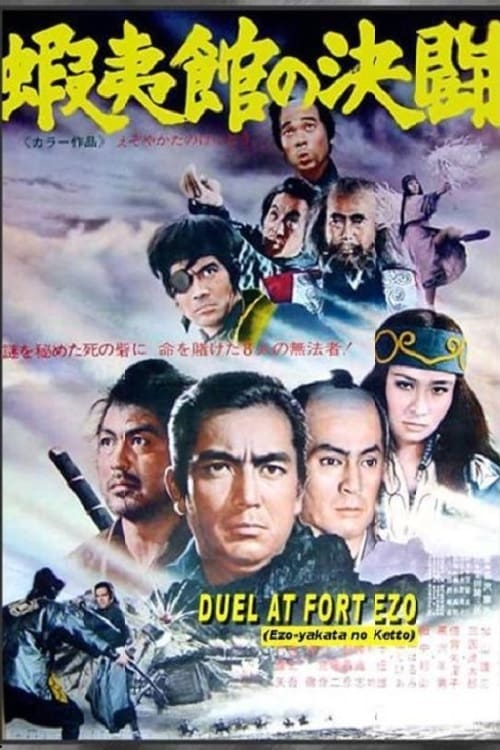
Duel at Fort Ezo
Plot
1864. Samurai Shinbei is sent in a secret mission to Ezo, in the North of Japan, to stop riots of villagers commanded by Jirozaemon. A Russian count's daughter, the village leader's daughter and a secret treasure add up to the adventure.
Get the Weekly Woke Watchlist
New and trending movies scored for woke bias, preachy messaging, and forced political themes — before you waste your evening.
No spam. One useful email per week.
Overall Series Review
Categorical Breakdown
The narrative frames the conflict using an immutable characteristic, pitting the indigenous Ainu people, who are struggling against the central government, against the Yamato-majority protagonists, which aligns with an intersectional lens. The Ainu are depicted using heavy-handed stereotypes, referred to as 'savage natives' who wear headbands and worship a bear god, resembling the 'Cowboys and Indians' trope. The central plot involves the corrupt Shogunate government attempting to orchestrate the destruction of a minority group (Ainu) for political and financial gain, illustrating a clear case of systemic oppression by the ruling majority. The true hero, Edo Saburata, is a political prisoner, setting up an anti-establishment framework where the protagonist is judged by his intellect and honor over his social status as a ronin/criminal.
The film's critique is directed at the Tokugawa Shogunate, portraying the central government as corrupt, duplicitous, and willing to betray multiple parties (Russians, Ainu) to steal gold and maintain power. This is a focused criticism of a specific political system during a historical transition, which aligns with anti-authoritarianism, not a generalized hostility toward the nation, civilization, or ancestors. The Russian foreign culture is also presented as an adversarial force seeking to gain a port through military means.
Gender dynamics are traditional. Women are not presented as 'Girl Boss' or dominant figures. The Russian count's daughter is a hostage who needs rescuing. The Ainu princess has a romantic subplot with the hero, which includes a highly anti-feminist trope where the character falls in love with her captor after sexual violence. The narrative celebrates male action, protection, and physical skill over female independence or perfection. Motherhood and anti-natalism are not themes in the adventure plot.
The plot is entirely focused on political intrigue, military action, treasure hunting, and a traditional male-female romantic subplot. There is no centering of alternative sexualities, no deconstruction of the nuclear family, and no discussion of gender ideology. Sexuality is treated as a private matter or via the explicit, anti-woke romantic trope.
The core conflict is political, involving the Shogunate, Ainu rebels, and Russian diplomats/military, with the goal being gold and political control. The Ainu are noted as worshiping a 'bear god,' but this is presented as a cultural trait, not a target for hostility or moral debate. The movie lacks a theme of traditional religion being the root of evil, and morality is defined by individual honor (the hero) versus state corruption (the Shogunate) rather than a subjective 'power dynamics' lecture.
Get the Weekly Woke Watchlist
New and trending movies scored for woke bias, preachy messaging, and forced political themes — before you waste your evening.
No spam. One useful email per week.