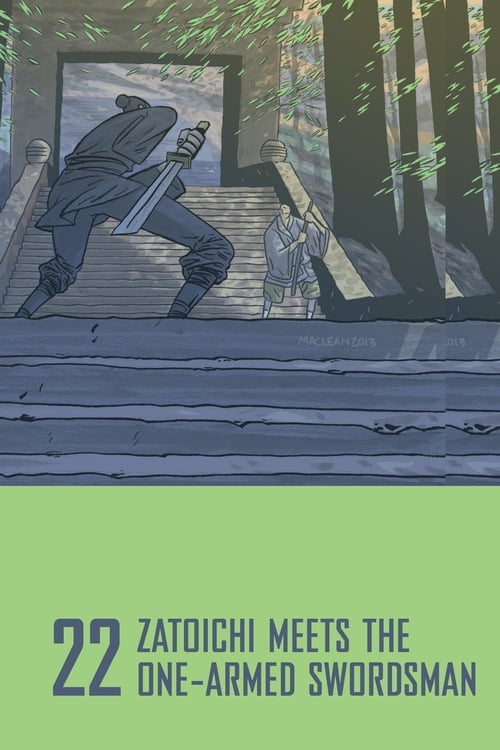
Zatoichi Meets the One-Armed Swordsman
Plot
Zatoichi is a blind massage therapist and swordsman who finds out that something troubling is taking place on the outskirts of town. After discovering who the guilty parties are -- an accomplished Chinese martial artist named Wang Kang and his youthful attendant -- Zatoichi finds them and discovers that the pair's mixed up with a dangerous bunch of terrorist samurai who murdered the boy's parents. Now, Zatoichi must step in to save the day.
Get the Weekly Woke Watchlist
New and trending movies scored for woke bias, preachy messaging, and forced political themes — before you waste your evening.
No spam. One useful email per week.
Overall Series Review
Categorical Breakdown
The narrative structure pits marginalized identities—the blind Japanese hero, the one-armed Chinese hero, other disabled characters, and Chinese immigrants—against the able-bodied Japanese power structure, which is the sole source of evil. Character merit drives the heroic actions, but the story's social commentary relies heavily on intersectional markers (disability and foreign status) to define who has integrity and who is corrupt. The Chinese protagonist, Wang Kang, is treated with respect and as an equal to Zatoichi.
The film criticizes the Japanese Edo-period system, depicting the 'imperial Japanese powers-that-be' as 'universally corrupt' and condemning the period’s feudalism and isolationism. This is a strong internal critique of the 'home culture’s' governing institutions. However, the ultimate hero, Zatoichi, is Japanese, which frames the conflict as an internal battle against systemic corruption rather than absolute civilizational self-hatred.
Female characters are mostly secondary and occupy traditional roles for the setting, such as Osen, a kindly prostitute and love interest, and Oyone, a woman seeking justice for her murdered family. The narrative centers on the two male protagonists' valor and action. There is no presence of 'Girl Boss' tropes, male emasculation, or anti-natalist messaging.
The story is an action-driven period film focused on martial arts, disability, and political corruption. There is no presence of alternative sexual ideologies, centering of sexual identity, deconstruction of the nuclear family, or gender theory lecturing. The structure remains strictly normative.
One of the central antagonists is a 'corrupt Japanese priest,' who represents the hypocrisy and rot within the ruling establishment. This targets a specific corrupt religious official rather than promoting moral relativism or condemning faith as a source of evil. The heroes are driven by an objective moral code of justice and protection for the innocent.
Get the Weekly Woke Watchlist
New and trending movies scored for woke bias, preachy messaging, and forced political themes — before you waste your evening.
No spam. One useful email per week.