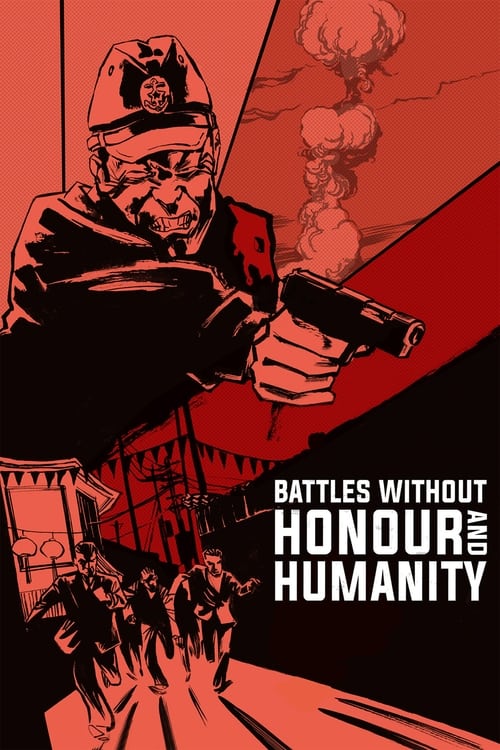
Battles Without Honor and Humanity
Plot
In the teeming black markets of postwar Japan, Shozo Hirono and his buddies find themselves in a new war between factious and ambitious yakuza.
Get the Weekly Woke Watchlist
New and trending movies scored for woke bias, preachy messaging, and forced political themes — before you waste your evening.
No spam. One useful email per week.
Overall Series Review
Categorical Breakdown
The plot focuses entirely on the internal conflicts of the yakuza, with character fates determined by their loyalty, ambition, and personal merit within the criminal hierarchy. All main characters are Japanese, authentic to the historical setting, with no reliance on race or intersectional hierarchy to drive the narrative or judge moral worth. Casting is entirely historically and geographically authentic.
The film offers a devastating critique of a corrupt subculture and the general moral decay of post-war Japanese society. The world is shown as lawless and chaotic. This is an intense, internal civilizational self-critique directed at post-war Japan's spiritual vacuum and political/social corruption, but it does not meet the definition of hostility toward Western civilization. The critique targets the failure of traditional Japanese criminal 'honor' and its replacement by raw greed.
The setting is the patriarchal, hyper-masculine world of the yakuza. The few women present are relegated to traditional roles as wives, mistresses, or bar workers, often seen serving or suffering. The narrative centers on male bonds and conflicts. There are no 'Girl Boss' or 'Mary Sue' tropes; rather, masculinity is shown as both protective (in Hirono's initial actions) and violently destructive (in the actions of most yakuza).
The narrative is completely focused on the all-male hierarchies, bonds, and conflicts of the yakuza. There is no presence of centering alternative sexualities, gender ideology, or deconstruction of the nuclear family. The default structure is a normative, hyper-masculine environment.
The film's core theme is moral nihilism, explicitly detailed in the title 'Battles Without Honor and Humanity.' The yakuza's supposed code (Jingi) is a complete lie, demonstrating that morality is subjective to power dynamics and self-interest. This moral vacuum negates a 'Transcendent Morality.' However, the film does not specifically target or depict hostility toward organized religion, especially Christianity, keeping the score in the low-to-mid range for general amorality rather than overt anti-theism.
Get the Weekly Woke Watchlist
New and trending movies scored for woke bias, preachy messaging, and forced political themes — before you waste your evening.
No spam. One useful email per week.