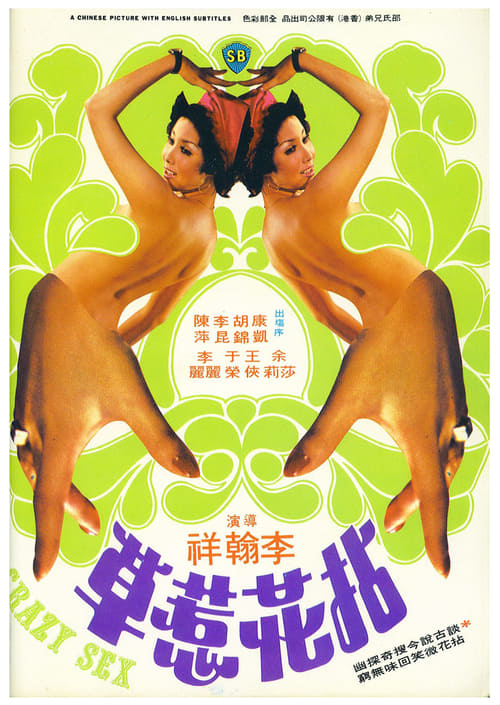
Crazy Sex
Plot
Shaw Brothers superdirector Li Han-Hsiang was particularly masterful in two genres: erotica and classic Chinese tales. He combined these two loves in this two-part examination of lust. The first story features an elderly jeweler's adventures with his unsatisfied wife, a handsome neighbor, and the neighborhood bordello. The second is a more modern tale of sex, lies, and videotape.
Get the Weekly Woke Watchlist
New and trending movies scored for woke bias, preachy messaging, and forced political themes — before you waste your evening.
No spam. One useful email per week.
Overall Series Review
Categorical Breakdown
The film is an all-Chinese production with all-Chinese characters, focusing on crime and adultery plots within Hong Kong society, both contemporary and historical. Race and intersectional characteristics are not plot points or sources of conflict. Characters are judged solely on their merit as criminals, lovers, cuckolds, or schemers, aligning with universal meritocracy.
The film is a sex-farce that criticizes individual moral failings such as lust and greed, rather than attacking Chinese civilization or heritage. The historical and contemporary settings are merely backdrops for immoral acts. The ancestors are not demonized, and the home culture is not framed as fundamentally corrupt in a civilizational sense, only corrupted by the human vices of the characters.
Female characters are the primary agents of deception and plot manipulation, using their sexuality and intelligence to outwit their husbands or criminal associates. The narrative centers on female infidelity and plotting to financially or sexually exploit the men around them, which strongly undermines the nuclear family. The focus on women achieving fulfillment through illicit sex and material gain gives a high score for anti-family and anti-natal messaging, even if the women are not 'perfect' Girl Bosses.
The entire sexual focus of the film is centered on traditional male-female pairings engaging in adultery and utilizing brothels. There is no presence of alternative sexualities, gender ideology, or deconstruction of biological reality. Sexuality is treated as a private, lustful matter, not a matter for ideological lecturing.
The first story involves criminals who display a clear lack of objective morality, operating on power dynamics and greed. The second story includes a light, comedic sequence where a wife employs a shaman to perform a fake exorcism, which uses a spiritual figure for a farcical deception. This use of a spiritual element as a comedic tool to facilitate immoral acts gives a moderate score for moral relativism and a low-level disregard for spiritual figures.
Get the Weekly Woke Watchlist
New and trending movies scored for woke bias, preachy messaging, and forced political themes — before you waste your evening.
No spam. One useful email per week.