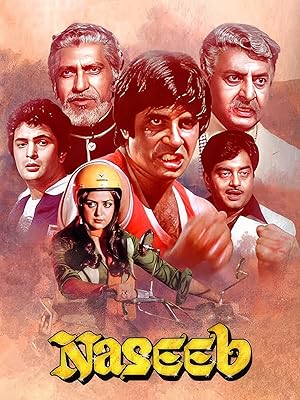
Naseeb
Plot
Naseeb, a story of destiny and fate, begins with a lottery ticket. A drunk who cannot pay his tab trades his 'winning' ticket to the waiter, Namdev (Pran), instead. Namdev decides to share this ticket with his three friends Damu (Amjad Khan), Raghu (Kader Khan) and Jaggi (Jagdish Raj). But when it turns out to actually be a winner, Damu and Ragu turn on the other two, murdering Jaggi and framing Namdev. Namdev goes on the run but Raghu and Damu intervene and throw him over a bridge into a river and Namdev is presumed dead. However he is rescued by a don (Amrish Puri) but no one is aware he is alive. Fast forward to ten years later - Damu and Raghu have used their stolen lottery money to build a fabulous hotel and make millions becoming very successful businessmen. Damu has used a share of his money to send his only son, Vicky (Shatrughan Sinha) to school in England. They have even employed Namdev's oldest son Johnny (Amitabh Bachchan), Vicky's best friend, as a waiter in the hotel. By coincidence (or by fate!) Johnny and Vicky who are the best of friends fall in love with the same beautiful singer, Miss Asha (Hema Malini). Julie (Reena Roy) is a childhood friend of Vicky's who is in love with Vicky, but he only sees her as a friend. When Johnny discovers this, he and Julie sacrifice their own love to ensure that Vicky and Asha get together. At the same time, John's younger brother Sunny (Rishi Kapoor) has fallen for Asha's younger sister, Kim (Kim). Kim and Asha also happen to be the daughters of Jaggi, the man Namdev supposedly murdered. Namdev returns soon after and plans to take revenge against Damu and Raghu for separating him from his two sons Johnny and Sunny. The lives of all these characters become inter wined and Naseeb becomes a poignant story about love, friendship, sacrifice, deceit, revenge and above all, destiny.
Get the Weekly Woke Watchlist
New and trending movies scored for woke bias, preachy messaging, and forced political themes — before you waste your evening.
No spam. One useful email per week.
Overall Series Review
Categorical Breakdown
The plot focuses entirely on universal themes of greed, loyalty, and justice, all judged by character merit rather than group identity. The lead character, John Jaani Janardan, is given a name that deliberately represents Christian, Muslim, and Hindu faiths, promoting a colorblind, national unity perspective. The central conflict is between working-class virtue and the corruption of sudden wealth, not systemic privilege based on race or immutable characteristics.
The film is a quintessential product and celebration of Indian 'masala' cinema, relying on high-stakes drama and family values. Institutions like friendship, family, and the nation are viewed positively, serving as the very fabric that the heroes fight to restore. The villains are individuals who betray their friends for money, not avatars of a fundamentally corrupt or racist home culture. There is no deconstruction of heritage or demonization of ancestors.
Female characters like the singer Asha and the friend Julie are portrayed as attractive, talented, and headstrong, but their character arcs are deeply rooted in traditional romance and sacrifice. Julie and Johnny sacrifice their own love to ensure the happiness of another heterosexual couple. While Asha has a singing career, the narrative's primary resolution is the pairing of men and women into complementary romantic units, not the promotion of career as the sole female fulfillment or the demonization of males as bumbling idiots. The gender dynamics reflect a traditional complementarian structure focused on love and family ties.
The narrative structure adheres strictly to normative romantic pairings (male-female) and the traditional nuclear family dynamic. The plot's resolution is about reuniting and creating new, traditional families. There is no presence of alternative sexual ideologies, deconstruction of the nuclear family, or lecturing on gender theory. Sexuality remains a private matter confined to the conventional love-interest subplot.
The movie's title, *Naseeb*, meaning 'Destiny' or 'Fate,' underscores a belief in a transcendent force guiding human events, which is contrary to moral relativism. Characters' actions are judged by an objective moral code where greed (the sin of the villains) is evil and sacrifice and loyalty are virtues. One scene even features a line suggesting a selfless act is so pure it 'will make God cry,' explicitly acknowledging faith as a moral reference point.
Get the Weekly Woke Watchlist
New and trending movies scored for woke bias, preachy messaging, and forced political themes — before you waste your evening.
No spam. One useful email per week.