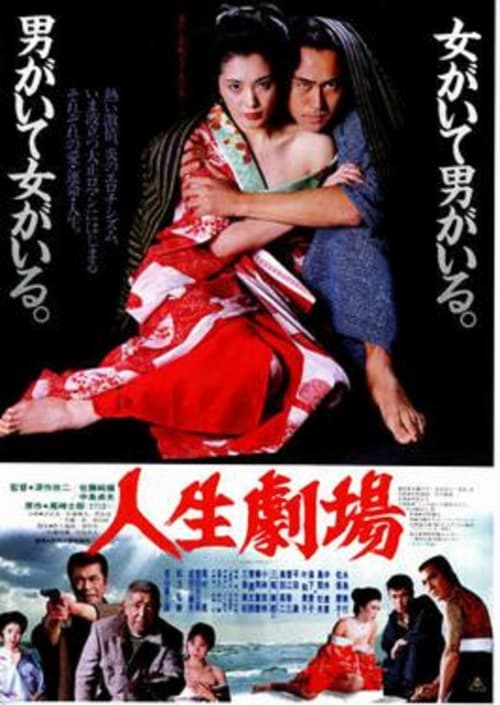
Theater Of Life
Plot
Adaptation of Shiro Ozaki's novel.
Get the Weekly Woke Watchlist
New and trending movies scored for woke bias, preachy messaging, and forced political themes — before you waste your evening.
No spam. One useful email per week.
Overall Series Review
Categorical Breakdown
The movie is a Japanese film with an entirely Japanese cast and setting. The narrative centers on a man's pursuit of political and financial ambition and the consequences of his moral compromises. Character definition relies on personal choices, family background, and adherence to codes of honor (yakuza) rather than on race or any intersectional characteristic. There is no presence of 'whiteness' to vilify or forced diversity, making the category's criteria irrelevant to the film's content.
The central conflict in the film involves a tension between the traditional values of honor, courage, and integrity championed by the protagonist's father and the rising 'materialistic values of rapidly Westernizing early-20th Century Japan.' The story offers a critique of the greed and corruption associated with modern capitalism and political maneuvering. This is a criticism of a specific cultural shift (mercantilism/modernization), not a wholesale demonization of Japanese culture or ancestors. The father's traditional virtues are presented as admirable but 'out-of-step,' which is a critique internal to the civilization, not civilizational self-hatred.
The female characters operate within the traditional yet complex gender roles of early 20th-century Japan. The abandoned sweetheart becomes a highly successful, nationally popular geisha, which is a position of status, talent, and agency, but still within a defined and non-natal traditional structure. The story depicts her heartbreak and life outside the traditional family unit, but does not frame motherhood as a 'prison' or emasculate men. The male figures, though flawed (one marrying for money, another a yakuza), are defined by their sense of duty, ambition, or honor, not by incompetence or toxicity as a blanket statement.
The core of the narrative is centered on a man's relationship with two women: his lost love who becomes a geisha and the woman he marries for convenience. The story is focused on traditional heterosexual romance, marital and extra-marital dynamics, and the family unit. There is no presence of alternative sexual identity as a theme, no deconstruction of the nuclear family as an 'oppressive' structure, and no focus on gender ideology or lecturing.
The film deals with themes of honor, duty, and fate which are rooted in a personal or cultural moral code, particularly the code of honor of the yakuza. The plot does not contain any hostility toward religion, specifically Christianity, or portray religious characters as villains or bigots. The moral stakes are existential and social (integrity vs. greed, honor vs. disgrace) rather than explicitly anti-theistic or a promotion of moral relativism.
Get the Weekly Woke Watchlist
New and trending movies scored for woke bias, preachy messaging, and forced political themes — before you waste your evening.
No spam. One useful email per week.