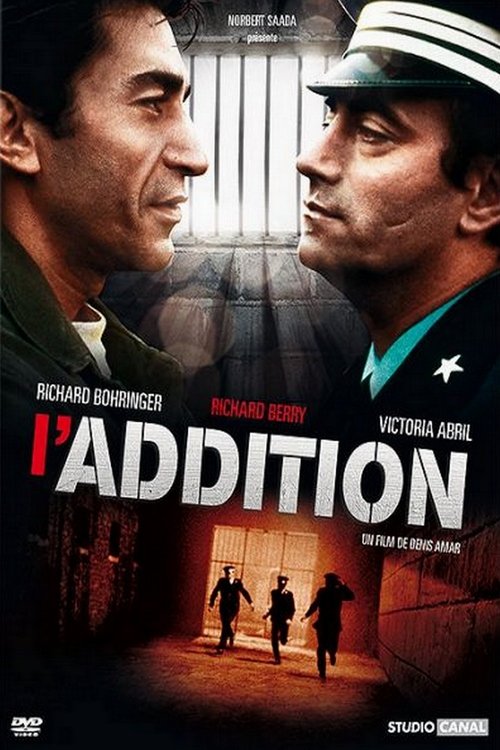
L'Addition
Plot
For having wanted to defend a young girl accused of theft, a comedian finds himself in prison. Embarked in spite of himself in an escape attempt, he is condemned by a particularly incompetent court which follows without thinking the pleadings of an overzealous public prosecutor! Once incarcerated, the poor comedian has to deal with the harassment of one of the guards, a kind of dangerous sociopath frustrated with life.
Get the Weekly Woke Watchlist
New and trending movies scored for woke bias, preachy messaging, and forced political themes — before you waste your evening.
No spam. One useful email per week.
Overall Series Review
Categorical Breakdown
The plot focuses on the unjust conviction of an innocent man based on personal misfortune and an incompetent justice system, not on his race or identity. Character conflict is based on personal merit (the hero's innocence) versus the malice of others (the guard’s sociopathy). The main antagonist is a white male guard. A secondary antagonist, a prison bully, is present, but the core conflict is divorced from intersectional hierarchy.
The film criticizes the incompetence and flaws of the contemporary French judicial and prison systems, depicting a broken bureaucracy and institutional cruelty. This is a critique of a specific modern institution that has failed to uphold justice, which is a key Western value, rather than a condemnation of Western civilization, home culture, or ancestors.
The female lead, Patty, is introduced as a 'charming kleptomaniac' whose actions are the catalyst for the protagonist's arrest. She serves as the devoted love interest and 'unfailing support' for the hero throughout his ordeal, even willing to commit violent acts for him. The dynamics are entirely traditional, with the man as the central figure enduring the ordeal and the woman as the devoted emotional force.
The core plot is a traditional thriller with a heterosexual romance. The antagonist guard’s harassment of the protagonist is noted as being 'spiced with a little homophobia,' suggesting the villain is homophobic, but this serves only as a character detail to underscore his malice, not to center or promote alternative sexual identity or queer theory in the narrative structure.
The film is a secular prison and court thriller with no discernible spiritual or religious themes. It does not display hostility toward Christianity or traditional religion, nor does it overtly promote faith or objective truth as a source of strength. The morality is centered on secular concepts of justice, innocence, and vengeance.
Get the Weekly Woke Watchlist
New and trending movies scored for woke bias, preachy messaging, and forced political themes — before you waste your evening.
No spam. One useful email per week.