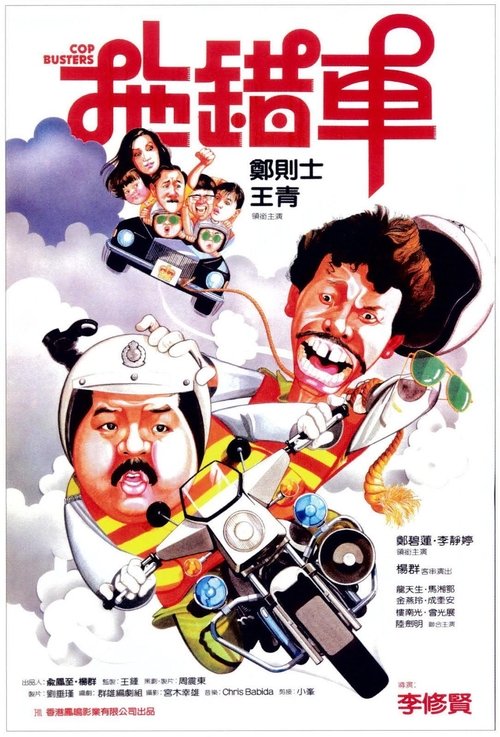
Cop Busters
Plot
Big Bear and Big Mouth were raised in the same orphanage. They worked in the traffic division of the police department for years. They were assigned to tow cars by their division commander; but on the first day of their assignment they mistakenly picked up a little girl named Bun. They were delighted to discover that Bun had an attractive aunt named Mary. In typical fashion, Big Mouth mistook Mary's show of affection as a show of love, and was devastated when she rejected him.
Get the Weekly Woke Watchlist
New and trending movies scored for woke bias, preachy messaging, and forced political themes — before you waste your evening.
No spam. One useful email per week.
Overall Series Review
Categorical Breakdown
The film is an 80s Hong Kong production, featuring exclusively Asian characters in an Asian setting. The narrative centers on the comedic merit and professional incompetence of the two male leads, not on any racial or intersectional hierarchy. There is no evidence of vilification of 'whiteness' or forced insertion of Western-style diversity. Character judgment is based on individual personality and actions, not immutable characteristics.
There is no demonstrable hostility toward Western civilization or self-hatred toward its own home culture of Hong Kong. The plot revolves around a local police precinct and its daily work, suggesting a baseline acceptance and engagement with the home country's institutions rather than their deconstruction or demonization.
The presence of an 'attractive aunt Mary' who is the romantic object of one of the male leads, only to reject him, places the gender dynamics within a traditional, male-driven comedic framework. Big Mouth is portrayed as a bumbling idiot who fails at romance, which is a form of comedic emasculation. However, the female character's primary function is as a love interest who exercises her choice to reject the male protagonist, preventing a '1' score but not rising to the level of modern 'Girl Boss' messaging.
As a mainstream action-comedy from 1985, the film adheres to a normative structure. The romantic subplot involves a traditional male-female pairing, and there is no indication of themes that center alternative sexualities, deconstruct the nuclear family, or engage with modern gender ideology. Sexuality is treated as a private matter for the romantic subplot, without public or political lecturing.
The film focuses on police work and low-stakes romance, not on a critique of religion. There is no evidence that traditional religion, specifically Christianity, is portrayed as the root of evil or that its adherents are depicted as bigots. Given the culture of origin, the film is expected to be neutral on Western religious themes, operating on a default of objective, non-secularized moral consequences tied to the action/crime genre.
Get the Weekly Woke Watchlist
New and trending movies scored for woke bias, preachy messaging, and forced political themes — before you waste your evening.
No spam. One useful email per week.