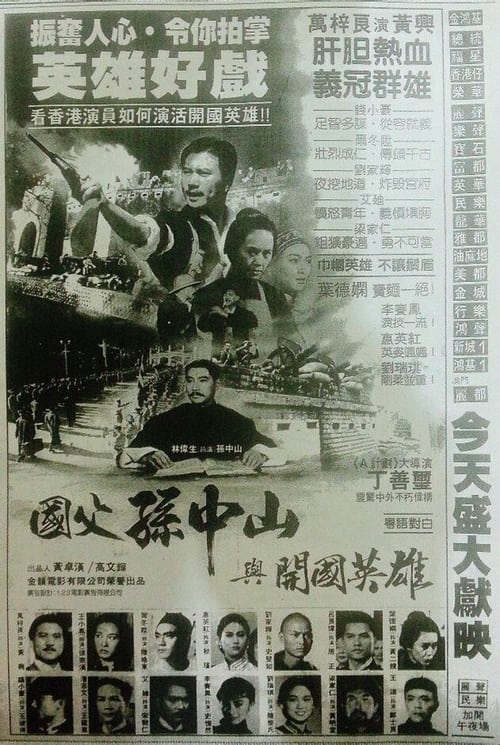
The Story of Dr. Sun Yat Sen
Plot
As befits the telling of the story of perhaps the most universally beloved hero of modern-day Chinese history Dr. Sun Yat-Sen (1866-1925), this lavishly produced biographical film uses techniques culled from Chinese Opera to dramatize the great man's political history. Concentrating on the period following his rise to political prominence in 1894 until his death in 1925, the movie is couched in terms of heroes who look heroic and villains who look villainous. Huge numbers of extras and vast battle scenes dot this production, and well-known Hong Kong and Taiwan-based movie stars appear in many cameos.
Get the Weekly Woke Watchlist
New and trending movies scored for woke bias, preachy messaging, and forced political themes — before you waste your evening.
No spam. One useful email per week.
Overall Series Review
Categorical Breakdown
Characters are judged by the content of their soul and revolutionary merit in the struggle to establish a modern republic, aligning with the principle of universal meritocracy. The conflict is national and political (overthrowing the Qing Dynasty), not based on a vilification of 'whiteness' or an intersectional hierarchy. The casting is historically authentic to the Chinese historical context.
The film promotes a clear sense of Chinese nationalism and civilizational renewal, framing Dr. Sun Yat-sen's revolution as the path to saving and modernizing the nation, which is the direct opposite of civilizational self-hatred. Dr. Sun's political philosophy is shown to respect and incorporate Western institutions and ideals, such as American democracy, without framing the West as fundamentally corrupt.
As a historical biopic about a male political leader, the narrative is male-centered, focusing on Sun Yat-sen and his male revolutionary comrades. Female historical figures, like Soong Ching-ling, are present, but their role is generally as strong-willed, supportive allies to the revolution, a form of historical complementarianism, not 'Girl Boss' or 'Mary Sue' figures who emasculate the male lead. There is no presence of anti-natalist or anti-family messaging.
The film is a political and historical epic from 1986 China, chronicling a national revolution. The entire focus is on political philosophy, warfare, and nation-building. There is no presence of alternative sexual ideologies, deconstruction of the nuclear family, or lecturing on gender theory.
Dr. Sun Yat-sen was a historical convert to Christianity, and his Western education and Christian faith are integral to his development as a revolutionary. The film's narrative promotes an objective moral and political truth through his 'Three Principles of the People' (nationalism, democracy, people's livelihood), which are framed as a higher moral law for the nation, and it contrasts with moral relativism. There is no hostility toward traditional religion.
Get the Weekly Woke Watchlist
New and trending movies scored for woke bias, preachy messaging, and forced political themes — before you waste your evening.
No spam. One useful email per week.