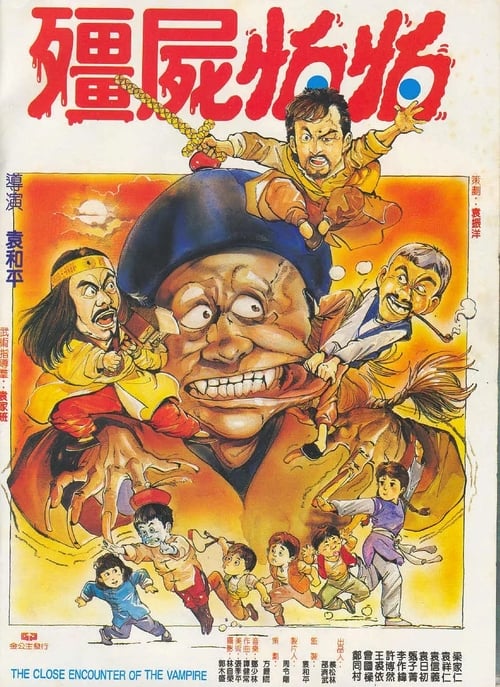
The Close Encounters of Vampire
Plot
A small town is plagued by a hopping Chinese vampire. A clumsy traveling warrior becomes aware of the vampire's sinister presence however the skeptical locals and their arrogant Taoist priest discredit the traveler. Meanwhile, a group of orphaned children, who are taken care of by a loving yet stern middle-aged play actor, befriend the vampire's son without realizing his true identity.
Get the Weekly Woke Watchlist
New and trending movies scored for woke bias, preachy messaging, and forced political themes — before you waste your evening.
No spam. One useful email per week.
Overall Series Review
Categorical Breakdown
The movie is a Hong Kong production set in historical China, featuring Chinese mythological creatures and an entirely Chinese cast. The central conflict is competence versus incompetence in martial arts and spiritual practice, not race or immutable characteristics. Character casting is culturally and historically authentic to the setting. There is no commentary on 'whiteness' or intersectional hierarchy.
The setting is a rural Chinese village, making the concept of hostility toward 'Western civilization' irrelevant. The critique is internal to the community, targeting the incompetence of the local spiritual leader and the skepticism of the villagers for failing to protect their home, not the fundamental institutions or ancestors of their own civilization. The story is about fighting an existential, external threat to the community.
The core of the children's storyline focuses on a male figure—a loving, stern play actor—who takes responsibility for and raises a group of orphans. This narrative celebrates a non-traditional but vital family structure and a protective, if flawed, fatherly role. Female characters are present among the orphans, including a teen girl who demonstrates competence in martial arts by fighting a thief, but the dynamic does not center on an anti-natal or 'Girl Boss' lecture, focusing instead on ensemble vitality.
The narrative centers on a supernatural horror-comedy involving a traveling exorcist, a local priest, and a troupe of orphans. There is no presence of alternative sexualities, centering of sexual identity, deconstruction of the male-female pairing, or discussion of gender ideology. The structure operates entirely on normative familial and spiritual roles for the time and place of the setting.
The entire plot relies on Taoist spiritual power, rituals, and talismans as the only force capable of defeating the supernatural evil of the *jiangshi*. The local priest is shown to be a 'sham Taoist' and arrogant, but this is a condemnation of a corrupt individual, not the transcendent moral law or the Taoist system itself, which the protagonist, another Taoist practitioner, ultimately uses to protect the town.
Get the Weekly Woke Watchlist
New and trending movies scored for woke bias, preachy messaging, and forced political themes — before you waste your evening.
No spam. One useful email per week.