Radioactive Dreams
Plot
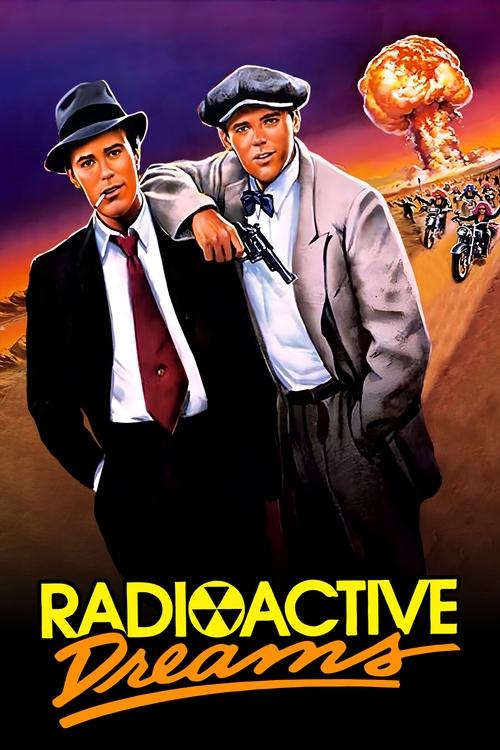
After an atomic war Phillip Hammer and Marlowe Chandler have spent 15 years on their own in an bunker, stuffed with junk from the 40s and old detective novels. Now, 19 years old, they leave their shelter to find a world full of mutants, freaks and cannibals. They become famous detectives in the struggle for the two keys that could fire the last nuclear weapon.
Get the Weekly Woke Watchlist
New and trending movies scored for woke bias, preachy messaging, and forced political themes — before you waste your evening.
No spam. One useful email per week.
Overall Series Review
Categorical Breakdown
The narrative does not center on race or intersectional hierarchy; the protagonists are white males whose primary characteristic is their sheltered innocence and their adopted persona of 1940s detective schtick. Antagonists are defined by their post-apocalyptic gang affiliation (mutants, cannibals, punks) and a desire for power, not immutable characteristics. Character conflict is purely merit-based: who is competent enough to survive and acquire the nuclear keys.
Western civilization is destroyed, having annihilated itself through nuclear war, which is the ultimate condemnation of the old world's failure. However, the two heroes actively cling to and celebrate a very specific piece of Western cultural heritage—1940s film noir and swing music—using this nostalgic style as their shield and identity in the chaos. The narrative condemns the world's self-destruction, but the heroes' action is an attempt to impose their own moral code based on a romanticized past onto the present chaos.
Gender dynamics lean into a film noir parody structure where the naive male detectives must contend with dangerous, competent women known as 'punk femme fatales.' This results in some women being depicted as highly capable antagonists, but this is a function of the genre's tropes, not a lecture on female supremacy or the 'Girl Boss' trope. The male leads are often bumbling and naive, but their character arc focuses on becoming 'hard-boiled'—a universal journey of experience, not emasculation as a political statement. There is no anti-natal or anti-family messaging outside of the fact that the post-apocalyptic world has physically destroyed family structure.
The narrative makes no attempt to center alternative sexualities or sexual ideology. The main male character acquires a female love interest who is a redeemed villainess, fitting a normative structure for the genre. The deconstruction of the nuclear family is a literal consequence of the nuclear apocalypse and the fathers' abandonment of their children, not a political or gender-theory lecture.
Religion and spiritual matters are entirely absent from the film's conflict. The plot is focused on a physical power struggle over a nuclear missile and the establishment of a crude new order. Morality is framed as the classic hard-boiled detective's internal code versus the amoral violence of the wasteland, not as a critique of organized religion or a promotion of moral relativism as a philosophical tenet.
Get the Weekly Woke Watchlist
New and trending movies scored for woke bias, preachy messaging, and forced political themes — before you waste your evening.
No spam. One useful email per week.