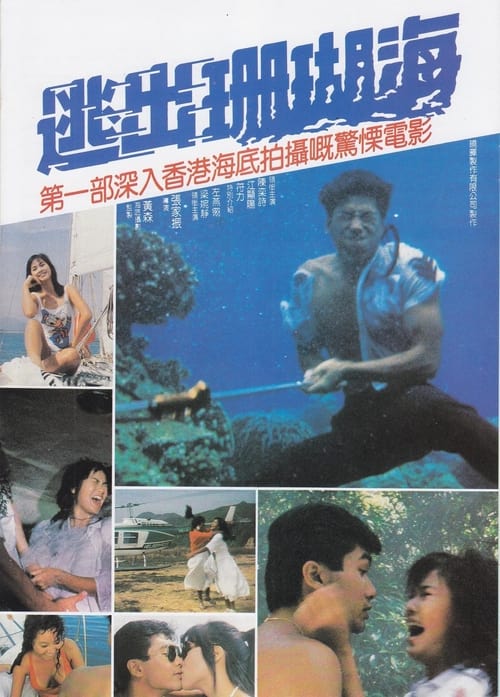
Escape from Coral Cove
Plot
A group of young, rich, boring idlers spends some summer days in the beach resort of Coral Cove. They waterski. They dive. They are jealous. They are potential final girls. One of 'em is called Four-Eyes and has a little brother. After hours of painful "excitement" with them, a friendly dead guy starts to kill off the annoying people. Instead of thanking the dead guy or making him president of the yacht club or something, a security guard calls his uncle, a buddhist exorcist. Too bad for him that he's a crap exorcist, and doesn't survive the meeting with dead guy.
Get the Weekly Woke Watchlist
New and trending movies scored for woke bias, preachy messaging, and forced political themes — before you waste your evening.
No spam. One useful email per week.
Overall Series Review
Categorical Breakdown
The movie is a Hong Kong production featuring an East Asian cast, so there is no theme of 'vilification of whiteness' or 'race-swapping.' Characters are defined by their wealth and lack of virtue, not their immutable characteristics. A minor class-based power dynamic is hinted at but is not the core lecture on systemic oppression.
As a Hong Kong film, the narrative does not engage in self-hatred of Western civilization or its ancestors. The focus is on a local supernatural monster and a critique of local superstition/religious methods, which does not constitute Oikophobia by the defined metric.
Gender dynamics are traditional and rooted in exploitation cinema. Women are objectified as 'bikini babes' and 'nubile friends,' and one is described as a 'one-note angel' 'final girl' of purity. The playboy male lead and jealous/catty female characters reinforce traditional, often negative, gender stereotypes without promoting 'Girl Boss' or anti-natalist messages. Masculinity is predatory, not emasculated.
The core relational dynamics revolve entirely around 'primal lusts' and love rivalry between traditional male-female pairings. The entire focus is on heterosexual attraction and objectification. There is no presence of alternative sexualities, gender ideology, or deconstruction of the nuclear family.
The movie treats religious figures (a Taoist master) as incompetent, failing to defeat the monster with traditional folk spells, or even borrowed Christian/Western supernatural tools like the crucifix and wooden stake. The climax is a victory of 'scientific ingenuity' over the supernatural, which frames faith and traditional religion as ineffectual and inferior to secular reason and science.
Get the Weekly Woke Watchlist
New and trending movies scored for woke bias, preachy messaging, and forced political themes — before you waste your evening.
No spam. One useful email per week.