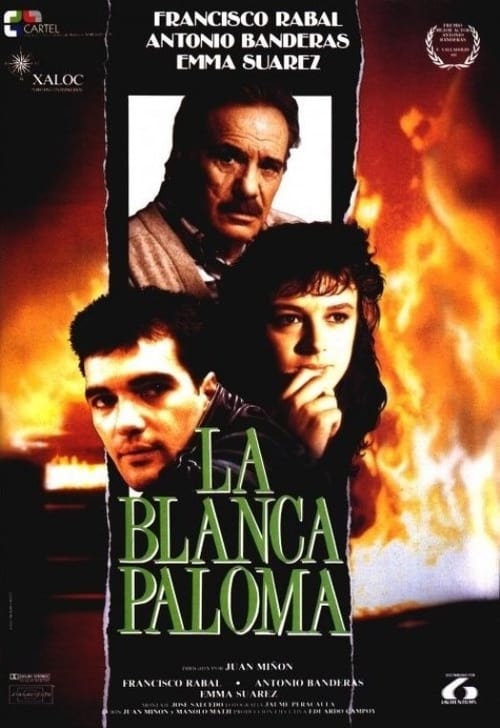
The White Dove
Plot
Rocío, is in love with Mario, a free rider with a lot of face that, to top it all, is partner of the business of her father, Domingo with whom she maintains incestuous relations. When Domingo passes away, both Mario and Rocío's mother have to put to the front of the business, finishing with the inheritance that could receive Rocío. In the midst of her frustration, a young business worker, secretly in love with Rocío, will try to have the legacy of her father end up in the hands of his rightful heiress.
Get the Weekly Woke Watchlist
New and trending movies scored for woke bias, preachy messaging, and forced political themes — before you waste your evening.
No spam. One useful email per week.
Overall Series Review
Categorical Breakdown
The film deals with a regional and class conflict by focusing on the 'tough reality of southern Spanish emigrants in Bilbao.' The conflict is rooted in socio-economic struggle and personal greed, not racial or intersectional hierarchy. There is no focus on vilification of 'whiteness' or forced diversity; characters are defined by their personal moral failures and their social class/regional background.
The narrative frames the home culture (the family, the business, the social environment) as fundamentally corrupt, violent, and intolerant. The foundational institution of the family is shown to be completely deconstructed through incest and immediate betrayal over money. This heavy focus on the moral degradation of the immediate environment and its people scores moderately high, as it views the 'home' as a source of chaos, not a shield, though it stops short of an explicit, sweeping demonization of a national heritage.
Rocío is a highly flawed female lead whose agency is rooted in her complicated, destructive passions and her struggle for inheritance. The film does not present a 'Mary Sue' or 'Girl Boss' trope; the women (Rocío and her mother) are complex, compromised agents in a moral disaster. The male characters are depicted as morally bankrupt (incestuous father, exploitative free-rider), but this serves the classic dramatic function of highlighting moral decay, not the modern trope of 'men as bumbling idiots' or a lecture on emasculation. The focus is on high-stakes human toxicity rather than an anti-natalist or career-over-motherhood message.
The core plot structure is a highly toxic, but traditional, heterosexual love triangle focused on lust, betrayal, and familial power dynamics, complicated by the act of incest. The narrative does not center alternative sexualities, deconstruct the nuclear family structure through a queer theory lens, or promote gender ideology. The sexual deviance depicted (incest) is framed as a moral horror, not as an alternative sexual identity to be celebrated or explored as a political concept.
The entire plot operates within a profound moral vacuum where characters engage in incest, betrayal, and greed, suggesting that morality is completely subjective and governed by 'power dynamics' (financial and sexual). While there is no explicit anti-theism or vilification of Christian figures, the complete lack of a transcendent moral framework and the normalization of extreme moral corruption as a facet of 'tough reality' aligns strongly with a sense of pervasive moral relativism.
Get the Weekly Woke Watchlist
New and trending movies scored for woke bias, preachy messaging, and forced political themes — before you waste your evening.
No spam. One useful email per week.