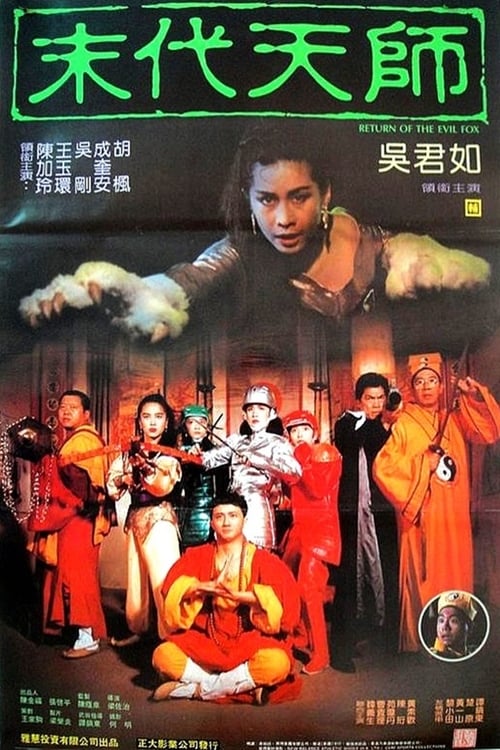
Return of the Evil Fox
Plot
1391: The good Chiang Su-Su manages to defeat the evil spirit Elf Fox, but has her soul transferred to a jasper incense holder and remains dormant for hundreds of years. In 1991 the Elf Fox returns to lethal life to wreak havoc on modern Hong Kong. The Elf Fox needs to absorb the souls of 108 men in order to obtain her full power. It's up to Su-Su's sweet descendant Yi, grouchy monk shopkeeper Chiang Wu, dashing, handsome foster son Wang Hsa, sassy ghostbuster Yu, and several others to defeat the Elf Fox before it's too late.
Get the Weekly Woke Watchlist
New and trending movies scored for woke bias, preachy messaging, and forced political themes — before you waste your evening.
No spam. One useful email per week.
Overall Series Review
Categorical Breakdown
The film is a Hong Kong production about Chinese folklore, so the casting is naturally authentic to the setting. The conflict is purely supernatural and moral, based on good spirits versus evil demons, making immutable characteristics or race irrelevant to the plot's central mechanism. The story focuses on the merit of spiritual power.
The plot affirms and celebrates traditional Chinese Taoist practices and the importance of ancestral knowledge as the only effective means to save modern Hong Kong from an ancient spiritual threat. It shows a deep respect for the home culture and its spiritual traditions.
The central villain is a powerful female demon, and a heroic ancestor is a female good spirit, showing a balance of gendered power. One female protagonist, the 'sassy ghostbuster' Yu, is materialistic and her aggressive pursuit of a man is played for comedy and framed as a source of her lack of appeal, subverting the 'perfect' female lead trope.
The narrative focus is on the normative male-female romantic pairing and the preservation of the traditional family unit (the Chiang clan) against an external spiritual threat. Sexual identity is not a central theme, and there is no focus on gender ideology or deconstructing the nuclear family.
The plot explicitly promotes a transcendent moral law and the power of traditional faith, as the heroes' success relies entirely on ancient Taoist mysticism. This affirms objective spiritual truth. The only mild hostility is a possible comedic or critical depiction of a secondary character who is a Christian preacher, which is a critique of one religion, not of faith or morality itself.
Get the Weekly Woke Watchlist
New and trending movies scored for woke bias, preachy messaging, and forced political themes — before you waste your evening.
No spam. One useful email per week.