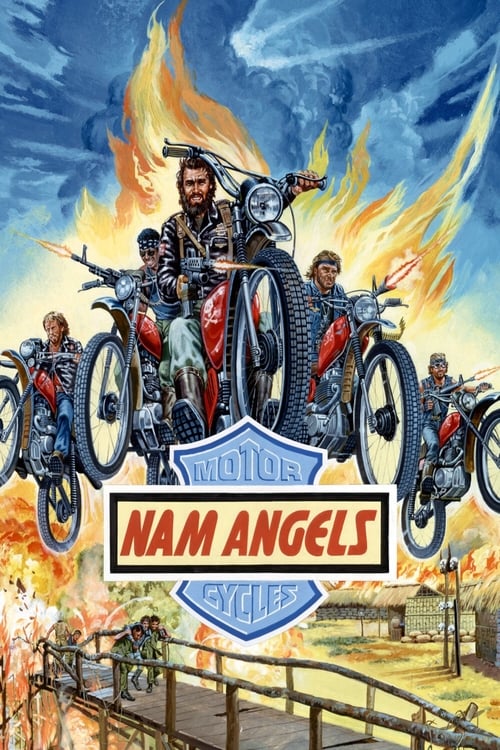
Nam Angels
Plot
Lt. Vance Calhoun takes on a dangerous rescue mission of American P.O.W.s in the treacherous Darloc Valley in Vietnam. His only chance to escape is with the help of five young, fearless soldiers on motorcycles.
Get the Weekly Woke Watchlist
New and trending movies scored for woke bias, preachy messaging, and forced political themes — before you waste your evening.
No spam. One useful email per week.
Overall Series Review
Categorical Breakdown
The narrative operates on universal meritocracy, where a diverse group of misfits—an Army lieutenant, a mechanic, and four outlaw bikers of various backgrounds—must prove their worth solely through action and shared survival. Character alliance is based on competence and courage in battle, not on intersectional hierarchy. The main villain, Chard, is a white mercenary, meaning the main threat is not defined by any racial or political group, but by individual avarice and betrayal.
The film does not frame Western civilization as fundamentally corrupt or racist. Instead, it directs hostility toward the military's senior command, portraying them as cowardly or bureaucratic for abandoning American POWs and refusing the rescue mission. This is a specific criticism of institutional failure, which ultimately validates the 'true' American, renegade spirit of the protagonists who show loyalty and sacrifice for their comrades.
The movie is a completely male-focused action story about soldiers and bikers. The entire plot centers on themes of masculinity, combat, and male camaraderie. There are no 'Girl Boss' or 'Mary Sue' tropes, and female characters are either absent or entirely peripheral. The complete lack of focus on gender politics, motherhood, or career fulfillment results in the lowest possible score due to the absence of the defined tropes.
The story is a straightforward 1980s action film from a genre that prioritizes combat and survival over social commentary. There is no presence of sexual ideology, centering of alternative sexualities, deconstruction of the nuclear family, or lecturing on gender theory. The normative structure of the era is maintained, and sexuality is entirely private and non-ideological.
The core conflict is secular, involving a rescue mission and a search for gold. There is no overt hostility toward religion, nor are any Christian characters depicted as bigots or villains. The film's conclusion uses a quote from John Milton, an acknowledgment of transcendent, if not explicitly Christian, spiritual themes, suggesting a baseline recognition of higher ideas without engaging in moral relativism.
Get the Weekly Woke Watchlist
New and trending movies scored for woke bias, preachy messaging, and forced political themes — before you waste your evening.
No spam. One useful email per week.