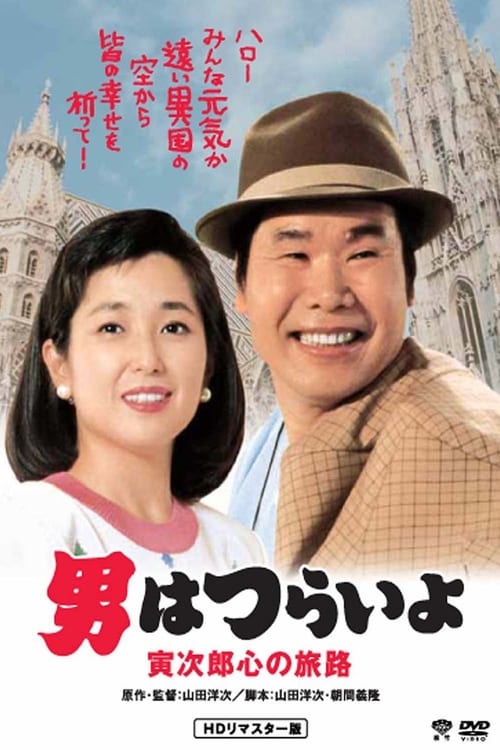
Tora-san Goes to Vienna
Plot
During his wandering throughout Japan, Tora-san meets a suicidal man. He travels with the man to Vienna, but winds up homesick for Japan.
Get the Weekly Woke Watchlist
New and trending movies scored for woke bias, preachy messaging, and forced political themes — before you waste your evening.
No spam. One useful email per week.
Overall Series Review
Categorical Breakdown
The narrative follows Tora-san, a Japanese national treasure character, and his family, with the central romance involving Japanese and Austrian characters. Character conflicts revolve around personal crises, homesickness, and unrequited love, not systemic oppression or intersectional hierarchy. The protagonist’s endearing nature and kind heart, despite his lack of sophistication, is the sole measure of his worth. All casting is historically and culturally authentic, devoid of forced diversity or racial commentary.
The central dramatic device is Tora-san's profound homesickness for his Japanese family and the traditional sweet shop in Shibamata. The film contrasts the grandeur of Vienna with Tora-san’s deep, unassuming attachment to his home culture, celebrating his enduring cultural rootedness. The foreign setting is used as a backdrop to underscore the value and appeal of the Japanese home, directly opposing the definition of civilizational self-hatred.
The female lead is the 'Madonna,' a hardworking tour guide who finds herself in romantic difficulty, which is a key part of the series' formula. The film centers on Tora-san's traditional male role as a well-meaning meddler and protective figure, whose attempts at romance are consistently unsuccessful. The narrative prominently features the protective, nurturing nuclear and extended family unit, including Tora-san’s sister and aunt, celebrating motherhood and family life.
The core relationships presented are entirely normative traditional male-female pairings, including Tora-san's unrequited love for the 'Madonna' and her entanglement with an Austrian man. The movie is widely described as family-friendly and wholesome storytelling, focusing on conventional romance and family structure. The narrative does not contain any centering of alternative sexualities or themes related to gender ideology or deconstruction of the nuclear family.
The movie is a lighthearted human-centered drama-comedy that emphasizes themes of deep humanity, kindness, and personal virtue. It is concerned with emotional truths and moral guidance for troubled characters, such as the suicidal executive Tora-san helps. The plot lacks any critique or portrayal of traditional religion as a source of evil, instead favoring a humanistic, transcendent morality where good intentions and family bonds are the ultimate sources of strength.
Get the Weekly Woke Watchlist
New and trending movies scored for woke bias, preachy messaging, and forced political themes — before you waste your evening.
No spam. One useful email per week.