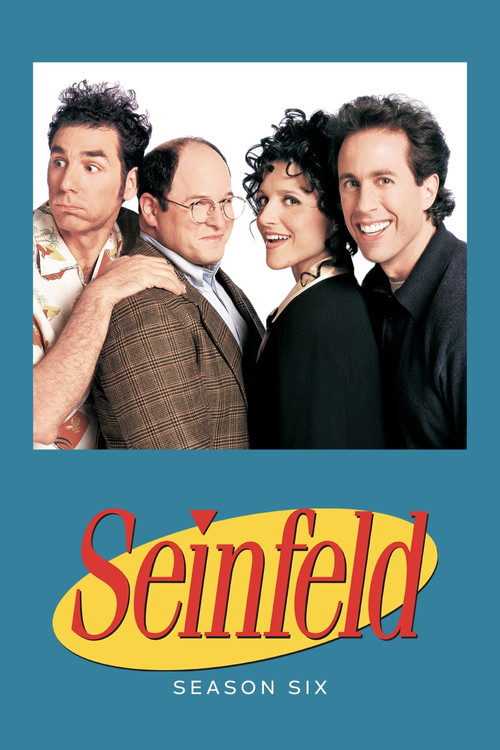
Seinfeld
Season 6 Analysis
Season Overview
No specific overview for this season.
Season Review
Categorical Breakdown
The narrative centers on the individual neuroses and common social awkwardness of the four main characters, not on race or intersectional hierarchy. The episode where George tries to prove he is not racist by counting his Black friends is a satire of an individual's anxiety about appearing racist, not a lecture on systemic oppression or privilege. The world of the show is functionally colorblind, judging characters solely by their level of annoyance and eccentricity, regardless of immutable characteristics.
The show is a 'show about nothing' that satirizes the trivialities of daily life in New York City, a contemporary setting. There is no hostility toward Western civilization, one's home, or ancestors. One episode explicitly references a character's anti-abortion stance being rooted in a family member's forced abortion in a gulag, which constitutes a strong philosophical criticism of a totalitarian, anti-Western system like Communism.
Elaine Benes is a career-focused, successful, single woman who frequently scoffs at the idea of having children, aligning with anti-natalist themes. The male leads, Jerry and George, are consistently portrayed as bumbling, incompetent, and insecure, which functions as a form of comic emasculation. Additionally, one episode features a clear pro-choice political statement when Elaine initiates a protest and walk-out because a restaurant owner is pro-life.
The core of the show’s conflict is the normative male-female dating structure, with sexuality presented as a source of awkwardness and social friction. Alternative sexualities are only featured in one episode where Elaine attempts to 'convert' a gay friend to heterosexuality to date him, a premise that directly challenges a modern queer theory lens and is played for purely comedic absurdity. The topic is not centered as an ideology.
The show operates from a philosophical position of moral relativism, where the characters are amoral and selfish, fulfilling the 'spiritual vacuum' criterion (4/10). The central creed is 'no hugging, no learning,' which denies the existence of a Transcendent Morality. However, there is no active, sustained hostility toward or vilification of Christian characters or traditional religion to warrant a higher score. Conflicts surrounding morality are handled with secular or humanistic reasoning.