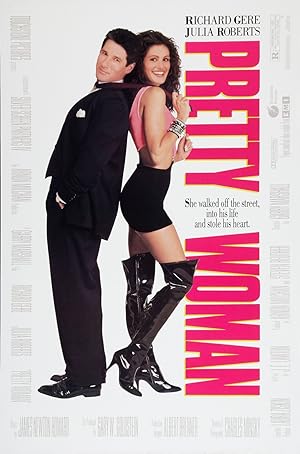
Pretty Woman
Plot
Because of his extreme wealth and suave good looks, Edward Lewis could seemingly have any woman he wants, that committed significant other which he needs on his arm at social events to further how he makes his money as a corporate raider. However, he focuses more on his corporate raiding pursuits with his partner in crime, Philip Stuckey, his lawyer of ten years, than those women, with every significant other he's had in his life feeling neglected and eventually leaving him, this fact about which he is just coming to the realization. In Beverly Hills, Edward, in needing that woman on his arms as he and Philip work toward taking over the company owned by the increasingly insolvent James Morse, decides, based on a chance encounter, to hire Hollywood Boulevard hooker Vivian Ward as his escort for the week 24/7. He does so because he wants to have a professional who would be committed to the work, yet not have any commitments to her after the week is over. Beyond their chance encounter, he also makes this decision because she surprises him about how unhookerish she is in certain respects. Vivian, relatively new to Los Angeles and the business, still has to look and act the part, with Edward, beyond giving her money, leaving her largely to her own devices to do so. So she gets a somewhat unlikely Henry Higgins in Barney Thompson, the manager of the Beverly Wilshire Hotel where Edward is staying. Barney has to draw that fine line of keeping the hotel's upscale clients happy, while maintaining the posh decorum of the upper class, which does not include people coming into the hotel looking for rooms with hourly rates. As Barney and his associates are able to transform Vivian into a Cinderella, the questions become whether Vivian can go back to her Hollywood Boulevard life and whether she does have her Prince Charming beyond this week in the form of Edward or anyone else who truly does see her as Cinderella as opposed to a Hollywood Boulevard streetwalker.
Get the Weekly Woke Watchlist
New and trending movies scored for woke bias, preachy messaging, and forced political themes — before you waste your evening.
No spam. One useful email per week.
Overall Series Review
Categorical Breakdown
The film centers on class divisions, not race or other immutable characteristics, with the main characters being judged by their moral character and 'content of their soul.' The villain, a white male corporate lawyer, is portrayed as immoral and abusive, which offers a minor critique of the 'white male' archetype of the corporate elite. The narrative structure is a 'Cinderella story' where the poor person's merit (innate goodness) is elevated by the opportunity of the rich person's money, a universal tale. The casting of the leads is colorblind in the context of the story's setting and time.
The film critiques the amorality and coldness of the American corporate upper class and the superficiality of Beverly Hills consumerism. It does not frame Western civilization, heritage, or institutions (like the nuclear family) as fundamentally corrupt. The movie utilizes and celebrates the classic Western 'fairy tale' trope, which serves as the ultimate aspirational goal for the characters. Institutions like the luxury hotel, represented by its kind manager, are shown to be polite and protective of tradition and decorum.
The core of the plot is a rescue and makeover fantasy, with the female lead's transformation and upward mobility being dependent on the male lead's wealth and patronage, which goes against the 'Girl Boss' ideal. However, the female lead, Vivian, is portrayed as possessing her own personal agency; she sets the terms of the relationship, is not a victim of a pimp, and quits her profession for self-respect. The narrative structure dictates that the male lead, Edward, is the one who must undergo a significant moral transformation, while Vivian's only major change is her wardrobe. The film celebrates the complementarity of their union, where the man is saved 'right back' by the woman's inner goodness.
The narrative focuses entirely on the courtship and eventual pairing of a heterosexual couple, a normative male-female structure. The film avoids any mention of alternative sexualities or gender ideology. The goal of the central relationship is a traditional romantic union and an implied future family unit.
The film does not engage with organized religion, but it promotes a clear, transcendent moral law. Edward's corporate raiding is explicitly framed as 'morally unethical' and his redemption comes from choosing love and human connection over mere profit. The central moral message is that 'true love' and goodness are the highest values, which provides an objective moral framework that stands in opposition to amoral or subjective 'power dynamics.'
Get the Weekly Woke Watchlist
New and trending movies scored for woke bias, preachy messaging, and forced political themes — before you waste your evening.
No spam. One useful email per week.