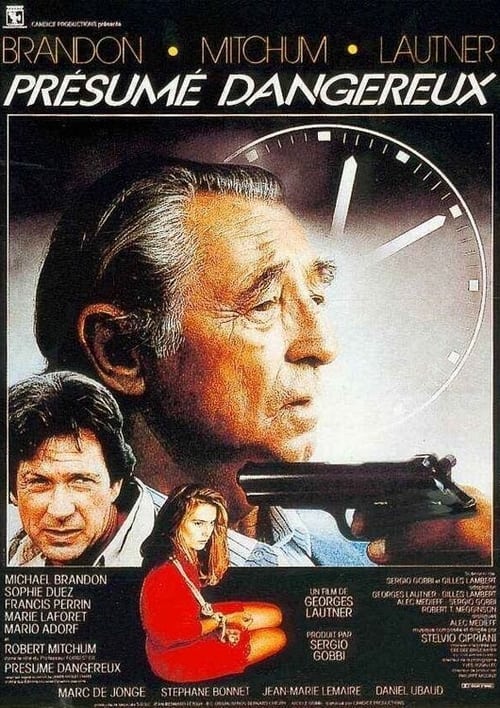
Believed Violent
Plot
Having developed a revolutionary device that puts water in the mouth of all secret services in the world, professor Forrester is about to go on a conference in San Francisco under the protection of Tom Lepski, an insurer.
Get the Weekly Woke Watchlist
New and trending movies scored for woke bias, preachy messaging, and forced political themes — before you waste your evening.
No spam. One useful email per week.
Overall Series Review
Categorical Breakdown
Characters are defined by their profession (scientist, insurer, spy, criminal) and their loyalty to national or criminal organizations, not by race or intersectional identity. The conflict is geopolitical and financial, with the main villain having ties to 'Russians and Chinese,' presenting a traditional East vs. West dynamic rather than a vilification of 'whiteness' or Western characters based on immutable traits.
The film does not frame Western civilization or heritage as fundamentally corrupt, but rather depicts the corruption of state agencies, a common trope in Cold War-era espionage thrillers. The French secret services are portrayed as amoral, choosing to chemically destroy the professor’s brain to protect the weapon's secret, which is noted as being 'against all ethics,' suggesting a moral critique of specific institutions rather than a civilizational self-hatred.
Gender roles are traditional and even punitive toward the female character. The entire central crisis is triggered by Professor Forrester catching his wife in adultery and murdering her lover, leading to his amnesia and downfall, fitting the pulp theme of a man's ruin by a 'scheming woman.' The narrative does not feature a 'Girl Boss' or 'Mary Sue' but rather a woman whose actions are the source of chaos and tragedy.
The narrative's focus is entirely on a heterosexual love-triangle gone violently wrong, international espionage, and corporate crime. There are no elements of alternative sexualities being centered, nor is there any presence of deconstructing the nuclear family as a social goal; the family unit is instead fractured by the melodrama of adultery and murder.
The conflict is secular, dealing with a supreme weapon, government secrecy, and criminal enterprise. The only spiritual-adjacent mention is a 'satanic psy' (psychiatrist) who is portrayed as an unethical, villainous figure, which reinforces a moral law by condemning his actions rather than embracing moral relativism or attacking religion.
Get the Weekly Woke Watchlist
New and trending movies scored for woke bias, preachy messaging, and forced political themes — before you waste your evening.
No spam. One useful email per week.