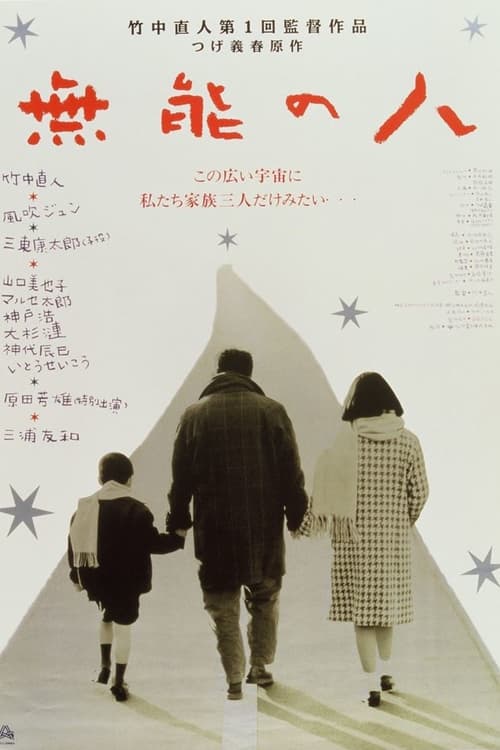
Nowhere Man
Plot
Sukezo, a former manga comic artist, takes up the art rock business by setting up a shop in a shed by the river. He tries hard to be successful, but business does not go well and the family becomes progressively poorer.
Get the Weekly Woke Watchlist
New and trending movies scored for woke bias, preachy messaging, and forced political themes — before you waste your evening.
No spam. One useful email per week.
Overall Series Review
Categorical Breakdown
The narrative focuses on the protagonist's personal lack of conventional talent and professional lethargy, a conflict centered on universal themes of success and failure in a consumerist society. Characters are judged by their economic viability and individual choices, not immutable characteristics or race-based privilege. The casting is culturally authentic to the Japanese setting.
The film functions as a critique against the dominant Japanese work ethic and materialism of the time, framing the main character as a passive figure left behind by economic prosperity. It questions the societal value placed on work and the need for economic success. This is a targeted critique of an institution, not a wholesale rejection or demonization of the culture's heritage or ancestors.
The male protagonist is depicted as incompetent and unable to provide for his family, which forces the wife, Momoko, to become the main economic support. This dynamic emasculates the male lead. However, the wife’s primary motivation is preserving the nuclear family unit and is entirely pro-family, not career-first or anti-natalist.
The movie focuses entirely on the traditional male-female pairing and nuclear family structure (father, mother, son). The plot and themes contain no elements of alternative sexualities, gender ideology, or a critique of the nuclear family structure.
Traditional religion is not a central theme, nor is there any explicit hostility toward faith. The protagonist instead embraces a philosophical, introspective path that prioritizes finding value in non-material things like river stones, which is a quest for personal meaning and a non-material morality outside of societal success.
Get the Weekly Woke Watchlist
New and trending movies scored for woke bias, preachy messaging, and forced political themes — before you waste your evening.
No spam. One useful email per week.