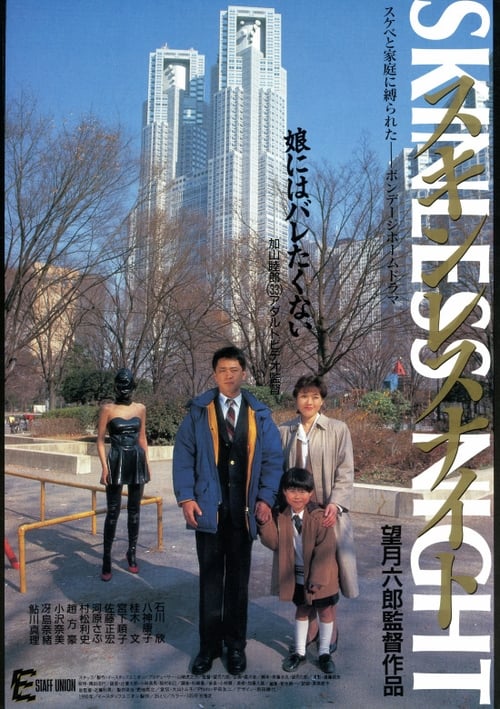
Skinless Night
Plot
Skinless Night (which borrows its title from a best-selling brand of condoms) centers on the 33-year-old Kayama Mutsuro, who supports his wife, child and a small team of employees by making porn videos. Profit margins are very low, the financier has his own troublesome ideas about the kind of tape he wants produced, the company office isn't an ideal environment for child-minding, and the job constantly throws up new challenges - like shopping for bondage gear or devising the special visual effects for a 'golden shower' scene. On top of everything else, Kayama is heading for a mid-life crisis. The rediscovery of his unfinished student film crystallizes his general sense of dissatisfaction, and leads him to rethink his life and work, to the chagrin of many of his friends, colleagues, and family members. Mochizuki's quasi-autobiographical début feature observes both the workings of the porn sub-culture and the spiritual problems of its central character.
Get the Weekly Woke Watchlist
New and trending movies scored for woke bias, preachy messaging, and forced political themes — before you waste your evening.
No spam. One useful email per week.
Overall Series Review
Categorical Breakdown
The narrative is focused entirely on the personal and spiritual crisis of the Japanese male protagonist, Kayama Mutsuro. No elements of race, intersectional hierarchy, or the vilification of 'whiteness' are present. The themes are universal: a middle-aged man's search for lost dreams and integrity. Character judgment is based on personal merit, ambition, and existential conflict, not immutable characteristics.
The movie is a critique of the protagonist's commercial life in the Japanese adult video sub-culture, not a wholesale indictment of Japanese or 'Western' civilization. The core conflict is a man's spiritual dissatisfaction and search for purpose. The movie is set entirely within the domestic and professional life of the protagonist in Tokyo and promotes no civilizational self-hatred or demonization of ancestors.
The main male character is portrayed as helpless, dreamy, and chasing the shadow of a youthful crush, which shows a man struggling with his maturity and responsibilities. His wife is part of the 'steadfast opposition' to his artistic dream, prioritizing the family's financial stability, which places her in a position of practicality against his dreaminess. While the male lead is depicted as 'helpless,' the narrative does not center on an idealized 'Girl Boss' female lead or lecture on the oppression of motherhood or marriage; the wife's role is a force of domestic realism.
The plot's setting is the production of commercial, primarily heterosexual, adult videos. The inclusion of topics like bondage gear and a 'golden shower' scene is a realistic depiction of the mundane aspects of the pornography industry, not a mechanism to promote queer theory, gender ideology, or deconstruct the nuclear family as a political concept. The core story centers on the traditional male-female pairing of Kayama, his wife, and his former crush, keeping the structure normative.
The protagonist's struggle is explicitly framed as a 'spiritual problem' and a search for 'integrity' and the 'rebirth' of his true self. This search for meaning operates in a secular space and does not involve hostility toward traditional religion. The narrative acknowledges the existence of a higher, objective truth (personal integrity/artistic calling) against moral relativism (the commercialism of porn) without vilifying Christianity or other traditional faiths.
Get the Weekly Woke Watchlist
New and trending movies scored for woke bias, preachy messaging, and forced political themes — before you waste your evening.
No spam. One useful email per week.