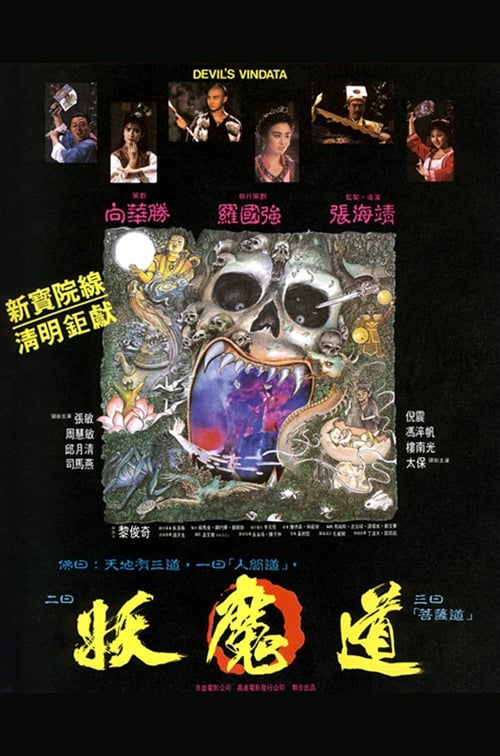
Devil's Vendetta
Plot
Two rival Taoist schools, one all-female, the other one all-male, must become allies to fight a demon as one of the priestesses is unaware that she's the daughter of the demon and has to lose her virginity to avoid turning into a demon herself.
Get the Weekly Woke Watchlist
New and trending movies scored for woke bias, preachy messaging, and forced political themes — before you waste your evening.
No spam. One useful email per week.
Overall Series Review
Categorical Breakdown
The film is a Hong Kong production with an entirely Asian cast, eliminating any possibility of a Western-style vilification of whiteness or historical race-swapping. Character is defined by spiritual power, supernatural lineage, and moral choices, not by a Western intersectional hierarchy or immutable characteristics.
The narrative is set entirely within an Eastern mythological and cultural framework. The story champions the defense of the world and the local culture’s moral order, represented by the Taoist schools and Buddhist forces, against a purely demonic evil. There is no hostility toward its own home, ancestors, or civilization.
The score is low but not the absolute lowest due to a complex dynamic. The all-female Taoist school is portrayed as highly capable and possessing spiritual power, suggesting strength in female agency. However, a central plot point requires the main female character’s salvation, and the world's safety, to hinge entirely on her losing her virginity in a pre-arranged, destiny-driven union. This focus on a traditional natalist/sexual role as a requirement for 'good' fundamentally contradicts modern anti-natalist 'Girl Boss' tropes. The male characters are often bumbling and 'horny' for comic relief, which slightly lowers the score from 1, but this is a classic comedic trope, not an ideological emasculation of heroic figures.
The core of the plot focuses on a traditional male-female pairing, defined by biology, being a necessary and urgent condition to defeat an ultimate evil. The entire structure reinforces the normative male-female structure and family concept as the basis for stability and good. The demon's initial transformation is a curse, not a commentary on gender identity.
The conflict is an explicit metaphysical battle between good and evil. Faith, specifically Taoist and Buddhist magic and spiritual law (including the intervention of Buddha), is the source of all power for the heroes and the foundation of objective morality. The film strongly affirms a transcendent moral order.
Get the Weekly Woke Watchlist
New and trending movies scored for woke bias, preachy messaging, and forced political themes — before you waste your evening.
No spam. One useful email per week.