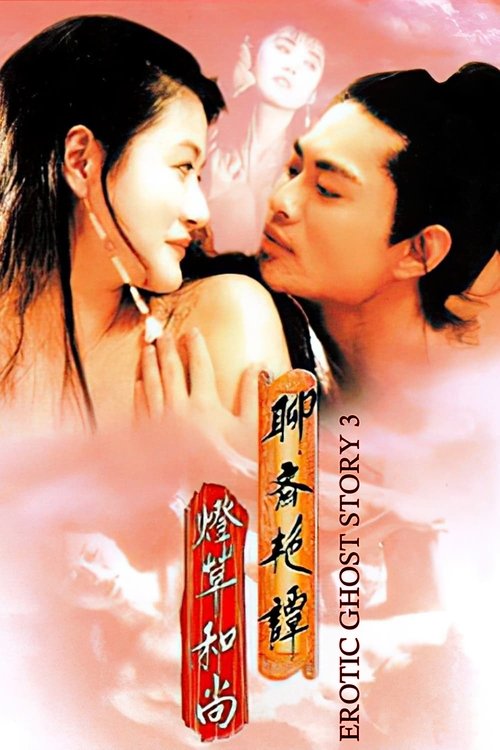
Erotic Ghost Story III
Plot
A wanderer meets a monk with magical powers and becomes entranced by a mural of exquisite dancing women. He enters the painting, unaware of the conspiracy behind it, and must rescue the women who are trapped within.
Get the Weekly Woke Watchlist
New and trending movies scored for woke bias, preachy messaging, and forced political themes — before you waste your evening.
No spam. One useful email per week.
Overall Series Review
Categorical Breakdown
The film is a 1992 Hong Kong production set in historical China and features an entirely Asian cast. The narrative conflict is supernatural and moral (mortal vs. demoness), entirely divorced from any modern concepts of race, intersectionality, or Western-centric privilege. Characters are judged solely on their moral actions and spiritual state, representing universal meritocracy.
The plot is a direct adaptation and continuation of classic Chinese ghost stories and folklore, set firmly within Ching Dynasty China. The narrative fully respects and utilizes the country's spiritual and cultural heritage, presenting institutions like the monkhood as a source of power and protection against spiritual chaos. There is no element of hostility toward Western civilization, nor is there any attempt to demonize the film's home culture or ancestors.
Gender dynamics are highly traditional and non-ideological. The primary female figures are ghosts or fairies who are predatory, seductive, or evil, functioning as supernatural temptresses who nearly ensnare the male protagonist. This directly contrasts with the perfect 'Girl Boss' trope. The film utilizes a clear male gaze and has an erotic-exploitation focus, presenting men and women in distinct, often objectified, roles. The protagonist's fiancée represents the normative, complementary female role.
The film focuses exclusively on male-female erotic and sexual dynamics as is characteristic of the Category III genre. The central relationships are heterosexual pairings (the scholar and the women/fairies/fiancée). There is no centering of alternative sexualities, deconstruction of the nuclear family unit, or discussion of gender ideology. The structure is entirely normative and sexuality is presented as a private, if highly explicit, matter of personal and spiritual conflict.
The conflict is fundamentally spiritual, featuring a heroic and magical monk (Reverend Wick) who uses his spiritual power to fight the forces of Hell, led by the demon Queen. The monk's Buddhist/Taoist faith is explicitly presented as a source of strength against true evil. The moral framework is objective (good vs. evil, salvation vs. damnation). Traditional religion is presented as the only means of rescue and transcendent morality is upheld.
Get the Weekly Woke Watchlist
New and trending movies scored for woke bias, preachy messaging, and forced political themes — before you waste your evening.
No spam. One useful email per week.