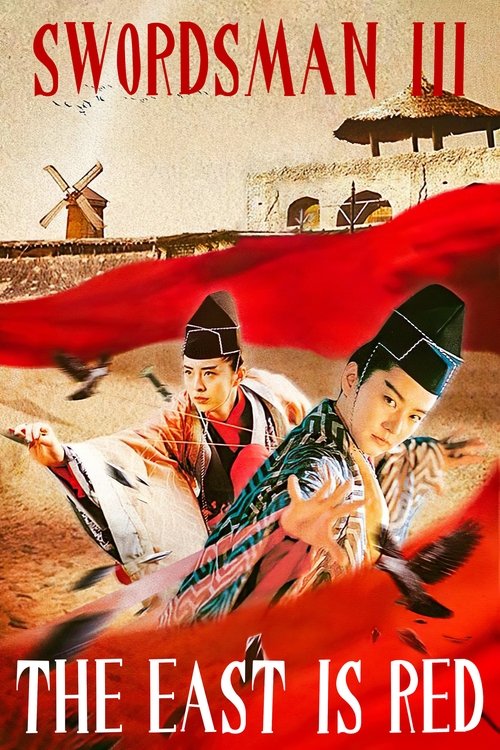
Swordsman III: The East Is Red
Plot
A royal official accompanies a Portuguese warship to the Black Cliffs to see the site of the defeat of the evil Invincible Asia, who attained supernatural abilities by following the sacred scroll and castrating himself.
Get the Weekly Woke Watchlist
New and trending movies scored for woke bias, preachy messaging, and forced political themes — before you waste your evening.
No spam. One useful email per week.
Overall Series Review
Categorical Breakdown
The narrative focuses on a power struggle within the Chinese martial arts world and the Ming Dynasty, not modern race-based or intersectional vilification. Characters are judged by their martial merit and lust for power. Foreign powers (Japanese, Dutch, Spanish) are depicted as greedy antagonists, but the main villain is Chinese.
The film is hostile toward the current Chinese regime, portraying the Ming Dynasty as oppressive and the martial arts world as chaotic and leaderless. This is a critique of specific corrupt institutions and the internal state of a nation, not a general rejection of Chinese civilization or heritage. Foreigners are also depicted as enemies.
Invincible Asia is a hyper-competent, all-powerful figure who attained her power and transcendent identity through emasculation (castration) and a female presentation. This character embodies the ultimate, albeit evil, 'Girl Boss' trope, showing a woman/female-identified figure as the most potent force. Another main female character is a powerful pirate captain with a crew of male lovers, completely subverting traditional gender roles and domesticity.
The core of the main character's identity and power is the physical transition from male to female via the sacred scroll's ritual, placing gender identity and fluidity at the absolute center of the film. The character is a symbol of sexual ambiguity. An explicit same-sex female relationship is a major emotional plot thread, centering alternative sexuality within the main story. This intensity of queer theme is extremely high.
The setting is a world in moral and spiritual chaos, where people follow 'false idols' in a spiritual vacuum. Ultimate power is achieved through a 'sacred scroll' that is explicitly shown as a corrupting, 'demonic' force. This frames the transcendent pursuit of power outside of traditional morality as destructive, suggesting an embrace of moral relativism and a lack of objective truth, though no specific religion like Christianity is targeted.
Get the Weekly Woke Watchlist
New and trending movies scored for woke bias, preachy messaging, and forced political themes — before you waste your evening.
No spam. One useful email per week.