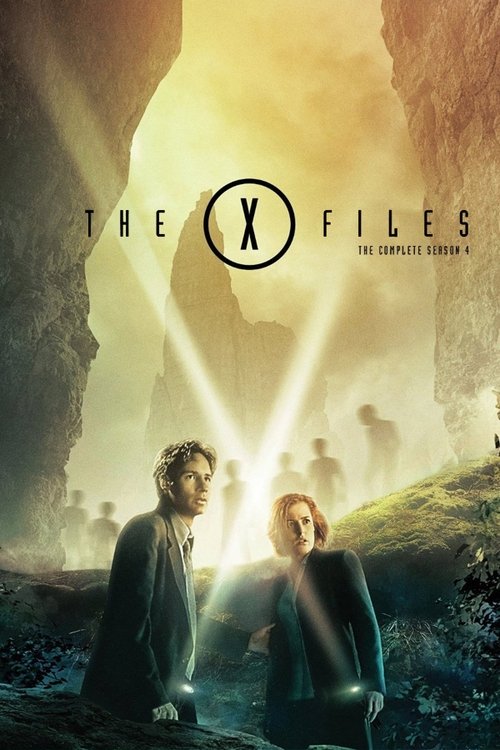
The X-Files
Season 4 Analysis
Season Overview
The prophetic words of the alien Bounty Hunter resonate throughout the fourth season, beginning with the near death of Mulder's mother and the murder of the mysterious X. Even the return of Alex Krycek and the alien black oil are overshadowed by Scully's cancer. Then the tragic reappearance of Max Fenig leads to the death of a fellow FBI agent. Yet even as these events strengthen Mulder's belief in a growing conspiracy, a startling truth revealed to Scully plunges him into a crisis of faith which could prove his ultimate undoing.
Season Review
Categorical Breakdown
Several 'monster-of-the-week' episodes center the plot directly around race, ethnicity, or religious minorities. 'Teliko' concerns a creature that preys on African-American victims and causes their skin to turn white. 'El Mundo Gira' features a deadly incident at a migrant workers camp. 'Kaddish' revolves around a murder in a Jewish community and the Golem legend. The narrative uses race and ethnicity as central elements in these specific horror and mystery plots.
The central, overarching conspiracy—the Syndicate—is a cabal of high-ranking, domestic government officials colluding with alien forces to betray the entire human race. Institutions of American government, specifically the FBI, military, and various shadowy intelligence wings, are depicted as fundamentally corrupt, powerful, and actively hostile toward the citizens they are sworn to protect. The narrative consistently shows the nation's leadership as fundamentally untrustworthy.
Dana Scully is a highly intelligent medical doctor and FBI agent whose scientific skepticism and analytical skills are essential to solving cases. She is an equal partner to Mulder, and the relationship is characterized by mutual respect and interdependence, not male incompetence. Scully is not a 'Mary Sue' as she faces a major, life-altering setback with her cancer diagnosis and confronts her own mortality. 'Never Again' shows Scully exploring personal desires and independence away from Mulder, but the overall presentation is one of complementary competence.
The season contains no explicit storylines or subplots focusing on non-traditional sexualities, sexual identity, or gender ideology. The core relationship is the heterosexual pairing of the two lead agents. The traditional male-female pairing and nuclear family structure (or lack thereof for the agents) serve as the normative structure.
The core evil in the show is institutional and alien in nature, not religious. While the episode 'The Field Where I Died' shows an American cult leader as a child-abusing sociopath, this portrays religious fanaticism and corruption, not religion itself as the root of evil. Scully's Catholic faith remains a respected part of her character, serving as a source of strength and moral grounding as she faces her cancer diagnosis in 'Memento Mori'.