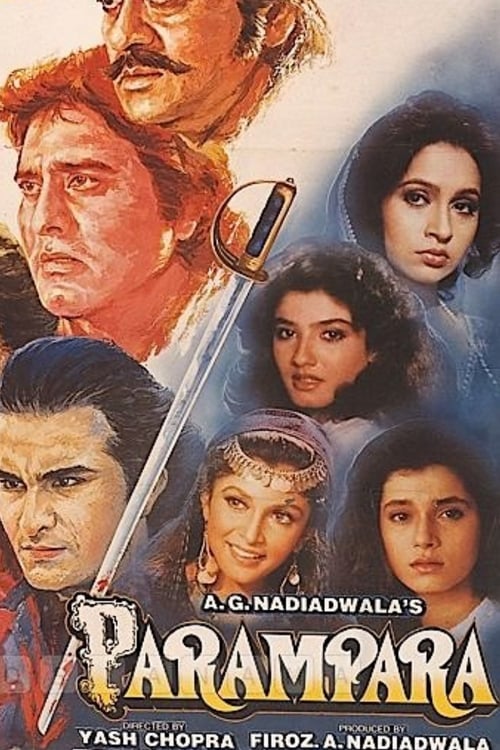
Parampara
Plot
In a remote region in India there has been a tradition of settling differences by fighting a duel with pistols with only one bullet in each of them. Such was the duel fought by Shankar and Thakur Bhavani Singh, with the latter emerging as the victor. Years later, Bhavani's son, Prithvi, returns from London, meets Shankar's son, Gora and daughter, Tara, befriends them, and eventually both Tara and Prithvi fall in love with each other. When Bhavani finds this out, he wants Prithvi to marry Rajeshwari, who comes from a rich family, and will destroy Gora Shankar and his tribe of gypsies. Unable to make up his mind, Prithvi ends up marrying both women, leading to Tara giving birth to a son, Pratap. Bhavani is enraged when he this out, he has Tara and a lot of their people slain, and their homes torched. Gora himself is arrested by the police, and sentenced to several years in prison...
Get the Weekly Woke Watchlist
New and trending movies scored for woke bias, preachy messaging, and forced political themes — before you waste your evening.
No spam. One useful email per week.
Overall Series Review
Categorical Breakdown
The central conflict pits a powerful, wealthy Thakur family against a marginalized 'gypsy clan,' grounding the plot in a group-vs-group social hierarchy based on tribe and class distinction. The narrative uses this group identity as the basis for the conflict, although the primary theme is the destructive cycle of tradition and revenge, not a lecture on systemic privilege or oppression.
The movie critiques the regional, feudal 'Parampara' (tradition) of dueling and the rigid, honor-based patriarchy that enforces it, which results in bloodshed and tragedy. The film's criticism is directed internally at a specific, harmful local practice, not Western civilization or Indian culture at large. The story suggests a more enlightened or universal perspective challenges the brutal local custom.
The female characters, Tara and Rajeshwari, are the catalysts and victims of the male-driven feud. They are defined entirely by their roles as wives, lovers, and mothers. The plot focuses on their tragic experiences arising from a man's indecision and the rigid social system. There is no presence of 'Girl Boss' tropes or anti-natalist messaging; motherhood is an important component of the ensuing generational conflict.
The narrative centers on a strictly heterosexual love triangle, polygamy within the context of the story's setting, and the continuation of the family line through sons. The focus remains on traditional male-female pairings and the nuclear family as the standard structure, with no element of alternative sexualities or gender theory introduced.
The film’s moral focus is on the burden of a destructive social and family tradition and the violence it causes. The story does not contain any hostility toward religion or religious institutions, nor does it advocate for moral relativism. The central moral dilemma is one of honor and tradition versus love and modernity, not a spiritual vacuum.
Get the Weekly Woke Watchlist
New and trending movies scored for woke bias, preachy messaging, and forced political themes — before you waste your evening.
No spam. One useful email per week.