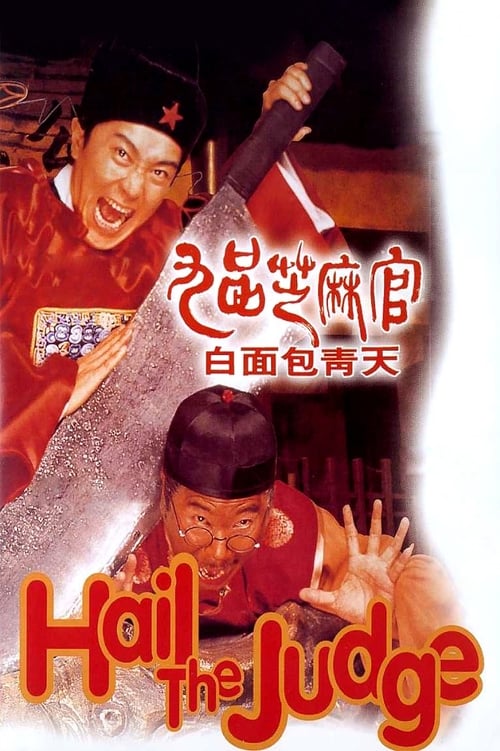
Hail the Judge
Plot
Pao Lung Sing, a descendant of the legendary Judge Pao Ching Tin, is a 9th degree corrupt judge who changes his tune when he tries to champion a woman Chi Siu-Lin, who was framed for killing her husband. As a result, Pao is forced to flee and through a series of events becomes a 1st degree judge and comes back to wreak havoc and justice on the guilty.
Get the Weekly Woke Watchlist
New and trending movies scored for woke bias, preachy messaging, and forced political themes — before you waste your evening.
No spam. One useful email per week.
Overall Series Review
Categorical Breakdown
The film features an entirely East Asian cast in a historical Chinese setting. The central conflict involves a corrupt political system being challenged by an individual who chooses to pursue justice, emphasizing character merit and universal principles (justice vs. corruption) rather than immutable characteristics. Race and ethnicity are not factors in the narrative's conflict or character definitions.
The narrative satirizes the Qing Dynasty's governmental and legal institutions, depicting officials and powerful families as deeply corrupt and decadent. This is a pointed critique of the established system and the aristocracy. The protagonist's transformation is driven by a desire to uphold the revered moral tradition of his ancestor, the legendary Judge Pao Ching Tin, which ultimately serves as a defense of traditional idealized virtues and heritage. The satire is aimed at corruption, not the deconstruction of the home culture itself.
The main female character, Chi Siu-Lin, is a framed victim of rape and murder who needs a male champion to secure her justice, which is antithetical to the 'Girl Boss' trope. The male hero, Pao Lung Sing, is initially bumbling and corrupt but becomes the competent, triumphant hero. He is rewarded in the end by being happily married to two wives, presenting a traditionally structured resolution. One notable female character, a brothel madam, provides the hero with the training he needs, which gives her agency but does not make her a 'Mary Sue.'
The story is set within a strictly traditional heterosexual framework. The plot revolves around a man saving a woman and his acquisition of two wives. The comedic elements include bawdy humor and brothel visits. There is no presence of sexual ideology that deconstructs the nuclear family or promotes alternative sexualities.
The entire plot focuses on the hero's moral journey from corruption to justice, which explicitly upholds an objective, transcendent moral law. The protagonist is named after a legendary historical figure known for his impartiality and justice, establishing an ideal moral authority for the story. The narrative is a quest for truth and justice against wickedness, not an attack on faith or morality.
Get the Weekly Woke Watchlist
New and trending movies scored for woke bias, preachy messaging, and forced political themes — before you waste your evening.
No spam. One useful email per week.